
How to Choose Fabric for Private Label T-Shirts
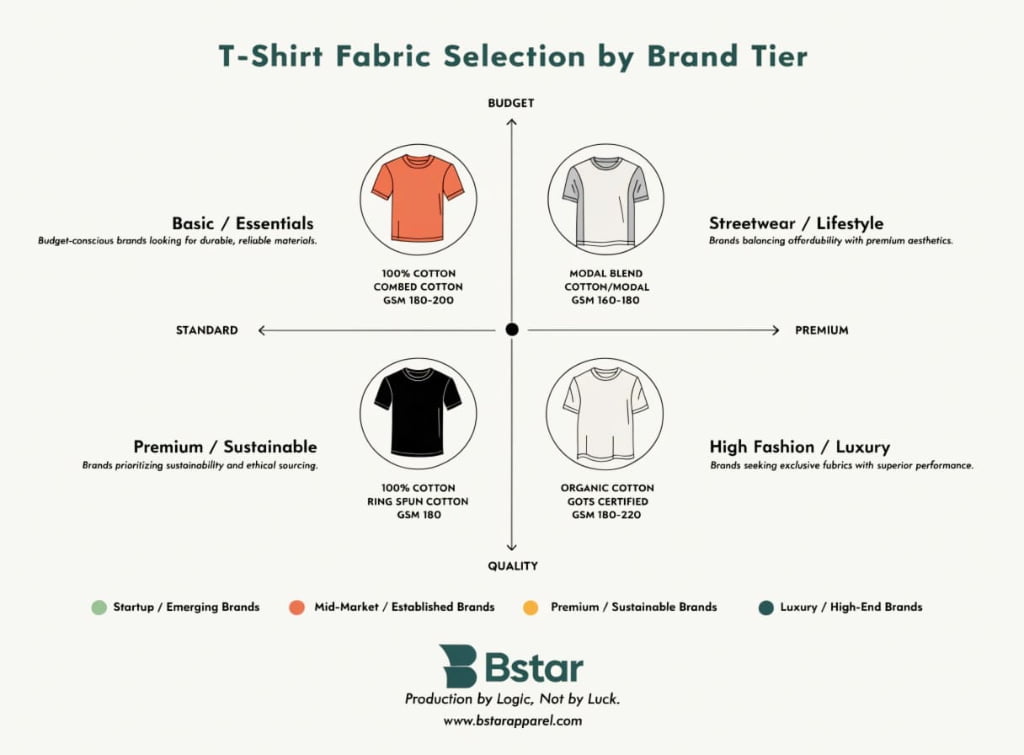
Choosing fabric for private label T-shirts feels like a small decision until it isn’t. Brands come to us after two or three sampling rounds, a failed buyer audit, or a product that looks premium in photos but feels cheap in hand — with a fabric spec that was decided too early, too casually, or based on the wrong criteria. The right fabric choice is a brand decision, a compliance decision, and a risk decision all at once.
The short answer: choose fabric for private label T-shirts by matching fiber composition, GSM, knit structure and finish to your customer, fit, decoration, budget and intended product claims. Compare physical swatches and decorated garment samples before and after the agreed wash test. A heavier fabric is not automatically better, and neither a blend ratio nor a certificate guarantees the hand feel or performance you want.
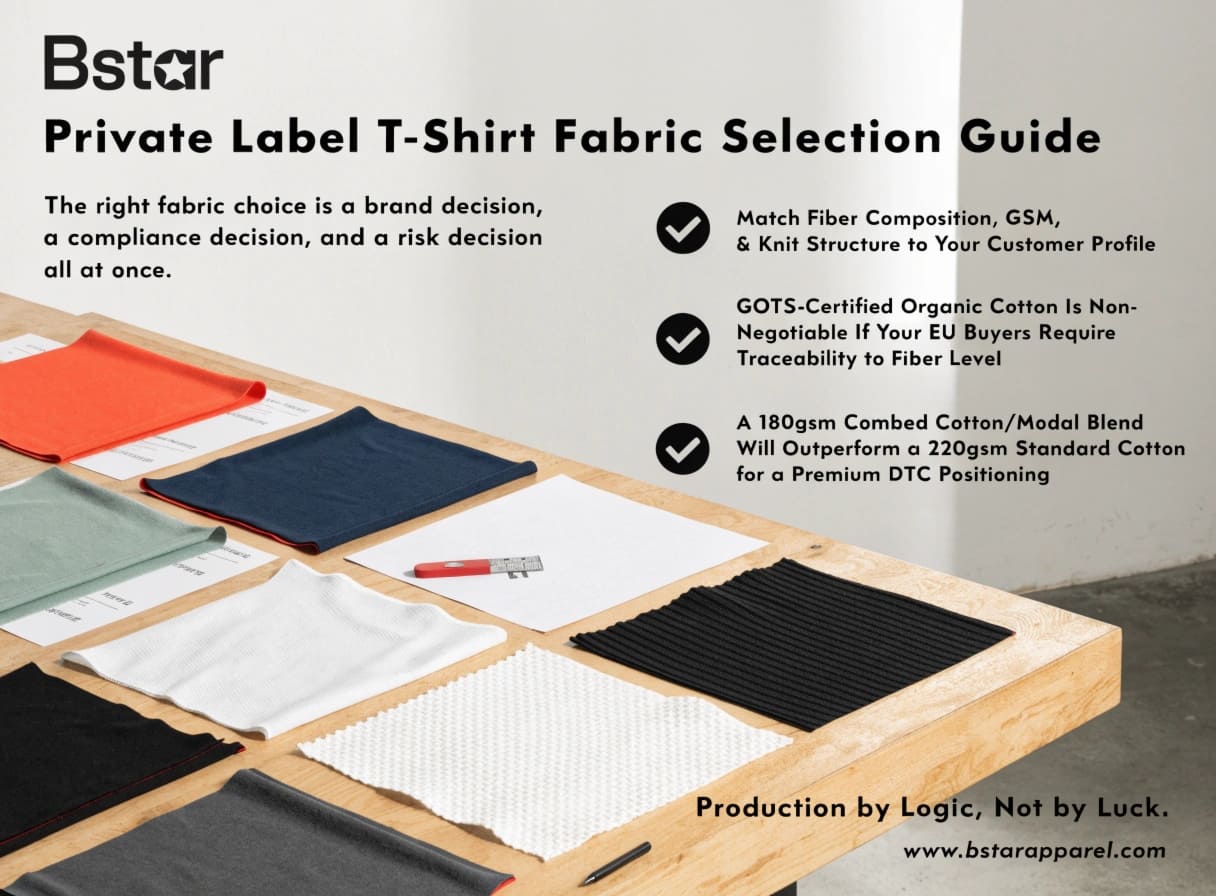
Selection note: the pictured weight comparison is not a tested performance ranking. Fiber traceability does not automatically require GOTS; define the specific product claim and buyer requirement.
Getting the answer right, though, depends on asking the right questions first — in the right order. Below, I’ll walk through exactly how we guide brands through this process, from customer profile to swatch approval.
How Should Your Target Customer, Fit and Budget Guide Fabric Selection?
Most brands start fabric conversations by asking "what’s the best fabric for a T-shirt?" That’s the wrong question. The right question is: who is wearing this, in what context, and what does the product need to feel like at the price you’re charging?
Before selecting fabric for a custom T-shirt project, outline your customer profile, intended fit and unit cost target. These give the first swatch comparison a purpose. They can be refined during development; identify what is fixed and what is still open.
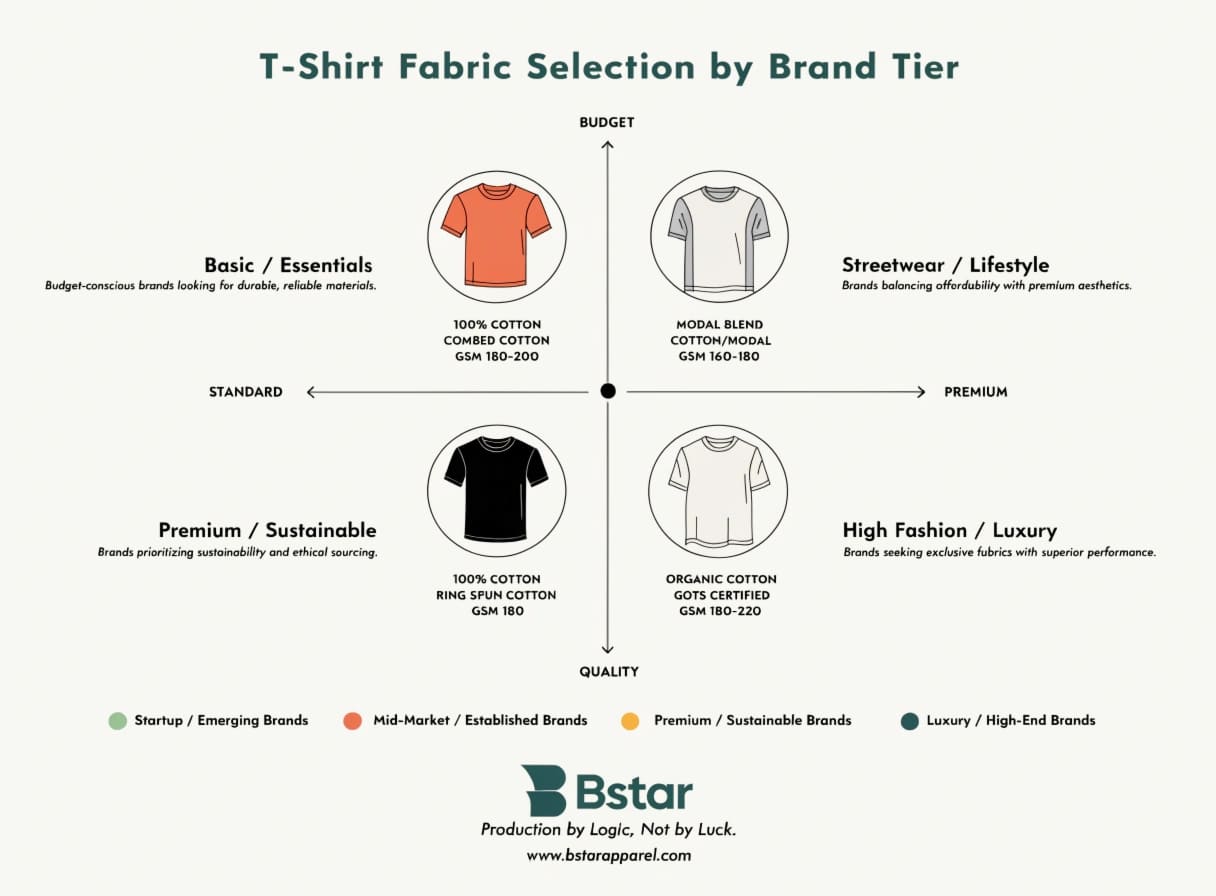
Positioning illustration: fabric names, weight bands and chart positions are discussion examples, not certified quality tiers or a price ranking.
Customer Profile Narrows the Fiber Conversation Immediately
A breathable summer basic for a Scandinavian activewear brand has almost nothing in common with a structured oversized tee for a US streetwear label — even if both are "100% cotton." When brands come to us without a clear end-use profile, we ask three questions upfront:
- Who is the end consumer? (Age, lifestyle, climate, sensitivity to care labels)
- What is the fit intention? (Relaxed, structured, body-fitted, oversized)
- What is the retail price point? (Budget, mid-market, premium, luxury)
These answers inform the GSM range, fiber type and construction. For example, an $80 fitted tee may call for a particular hand feel, fit and documented sourcing claim. A $25 basics pack still needs agreed durability, color and dimensional stability. These are illustrative price points, not fabric grades: neither price establishes the right composition or certification.
Budget Sets the Ceiling Before Fabric Selection Begins
In client consultations, we often see brands reverse this logic — they fall in love with a fabric in a showroom, then try to make the economics work afterward. That can mean revisiting both the fabric and the product brief.
Use the following comparison to identify what needs pricing. Request quotes on the same specification and quantity basis:
| Fabric Direction | Cost Factors to Confirm | Potential Use Case |
|---|---|---|
| Combed cotton, for example 180–200gsm | Yarn specification, construction, finish, color and quantity | Everyday basics where the approved swatch meets the brief |
| Combed ring-spun cotton, for example 180gsm | Confirm spinning and combing separately; compare like-for-like quotes | Smooth-surface basics or a defined printing program |
| Cotton/modal blend, for example 50/50 at 160–180gsm | Fiber identity, blend ratio, yarn, finish and actual availability | A softer or more fluid silhouette, subject to sample review |
| GOTS-certified organic cotton route | Required product claim, certified processing route and documentation | Programs with an agreed organic-certification requirement |
| Cotton/recycled-polyester blend | Verified recycled content, construction, finish and decoration needs | Programs where the proposed blend meets the intended use |
The weights and blends above are discussion examples, not quotes or guaranteed performance tiers. Availability and fabric or component minimums also affect the comparison; clarify them through MOQ and order planning. Record the chosen fabric and open questions in the custom T-shirt RFQ checklist.
Which Fiber Composition Is Right for Your Private Label T-Shirts?
"100% cotton" is not a fabric specification — it’s the beginning of one. When brands specify only fiber content without cotton type or processing method, they leave the most important variables undefined.
The cotton type, processing method and blend ratio help shape hand feel, shrinkage and pilling behavior. Yarn, knit construction and finishing matter too. Separately, check whether the proposed supply chain supports the specific sourcing or certification claim you want to make.
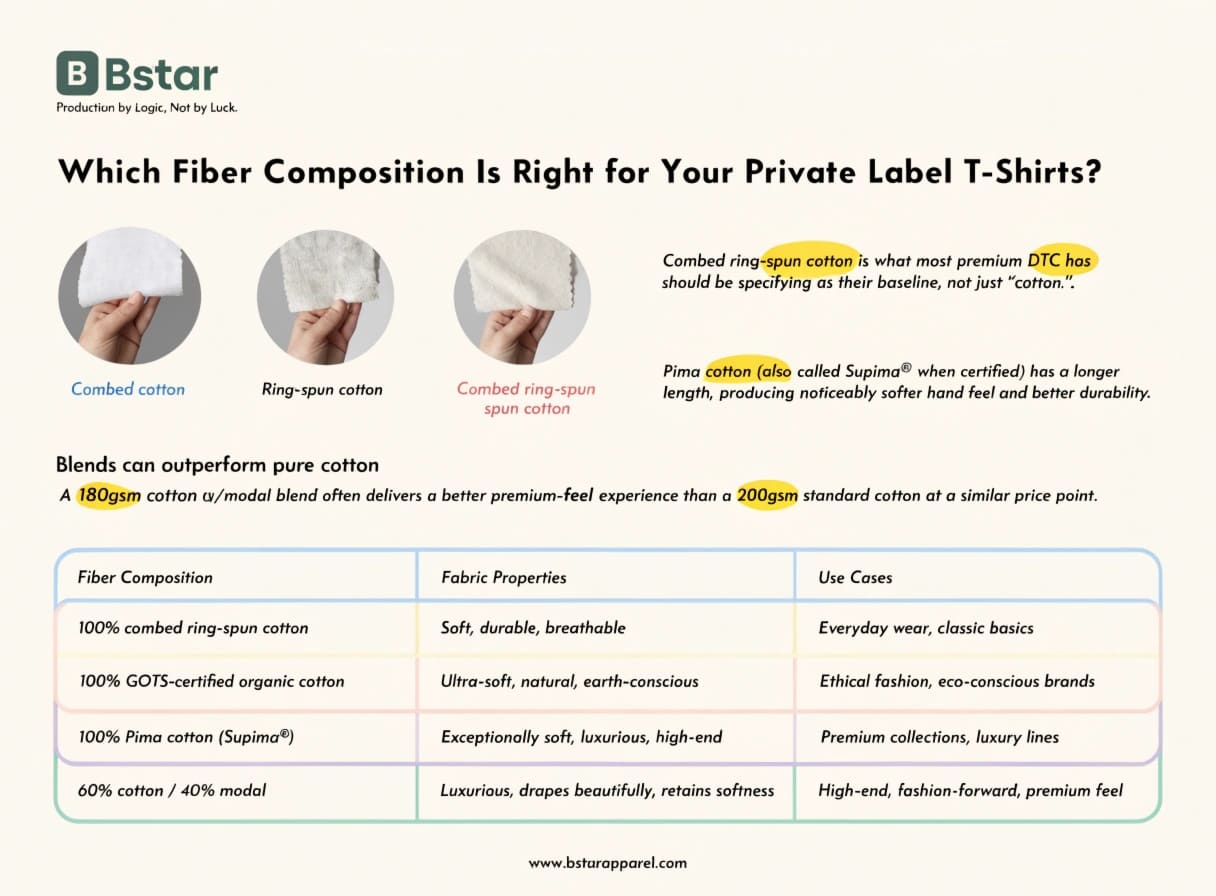
Fiber note: Supima® is a trademark for American-grown Pima cotton, not a generic certification for all Pima. The pictured blend/weight comparison is not a controlled performance result.
Cotton Type Is Not Interchangeable
Combing removes short fibers and impurities during yarn preparation; ring spinning is a spinning method. They describe different stages, so combed and ring-spun are not competing cotton types. Combed ring-spun cotton can be a useful option to sample for a smooth-surface tee, but approve the actual fabric rather than treating the name as a universal premium grade.1
Pima cotton is an extra-long-staple cotton category. Supima® is a trademark for American-grown Pima cotton, with authorization requirements for its use; it is not a generic name for any certified Pima fabric. If specified, request the relevant material identity and supply-chain evidence, then compare the finished fabric and quote.2
Generic “natural cotton” or “sustainable cotton” wording is not equivalent to an organic-certification claim. We consistently tell brands to agree the intended claim and check the supporting chain before ordering. At BSTAR, GOTS-certified fabric sourcing can be discussed through appropriately certified suppliers; this is not a statement that BSTAR’s factory or every finished garment is GOTS-certified.3 A buyer’s GOTS requirement is a specific sourcing requirement, not an automatic rule for every EU T-shirt order.
When Blends Are Worth Comparing with Pure Cotton
A cotton/modal blend around 180gsm can be worth comparing with a 200gsm cotton reference when the brief calls for a softer, more fluid tee. That is a sample comparison to make, not a performance ranking established by the two weights. Modal is a regenerated cellulosic fiber.4
What should you compare?
- Drape: does the actual fabric fall in the way the intended silhouette needs?
- Softness after washing: does the chosen fabric retain the approved hand feel under the intended care routine?
- Dimensional stability: measure the proposed blend rather than assuming modal content reduces shrinkage.
For a soft fitted tee, a 50/50 or 60/40 cotton/modal blend is worth sampling alongside cotton. Review the handle, photograph the actual garment and compare the quote. Lenzing describes its TENCEL™ Modal fibers as wood-based regenerated cellulose; its sourcing and softness statements apply to that branded fiber, not automatically to every fabric sold as modal.5 A wood-derived fiber does not by itself establish an environmental claim for the finished T-shirt.
How Do GSM and Knit Structure Affect Hand Feel, Opacity and Drape?
GSM is the variable clients ask about most — and misuse most. Higher GSM does not mean better fabric. It means heavier fabric, which is appropriate for some applications and wrong for others.
Knit structures such as single jersey, piqué and interlock work with GSM, yarn and finish to influence wear, washing and decoration. Slub describes a yarn-texture effect; it can be used in a jersey rather than being a separate knit structure.
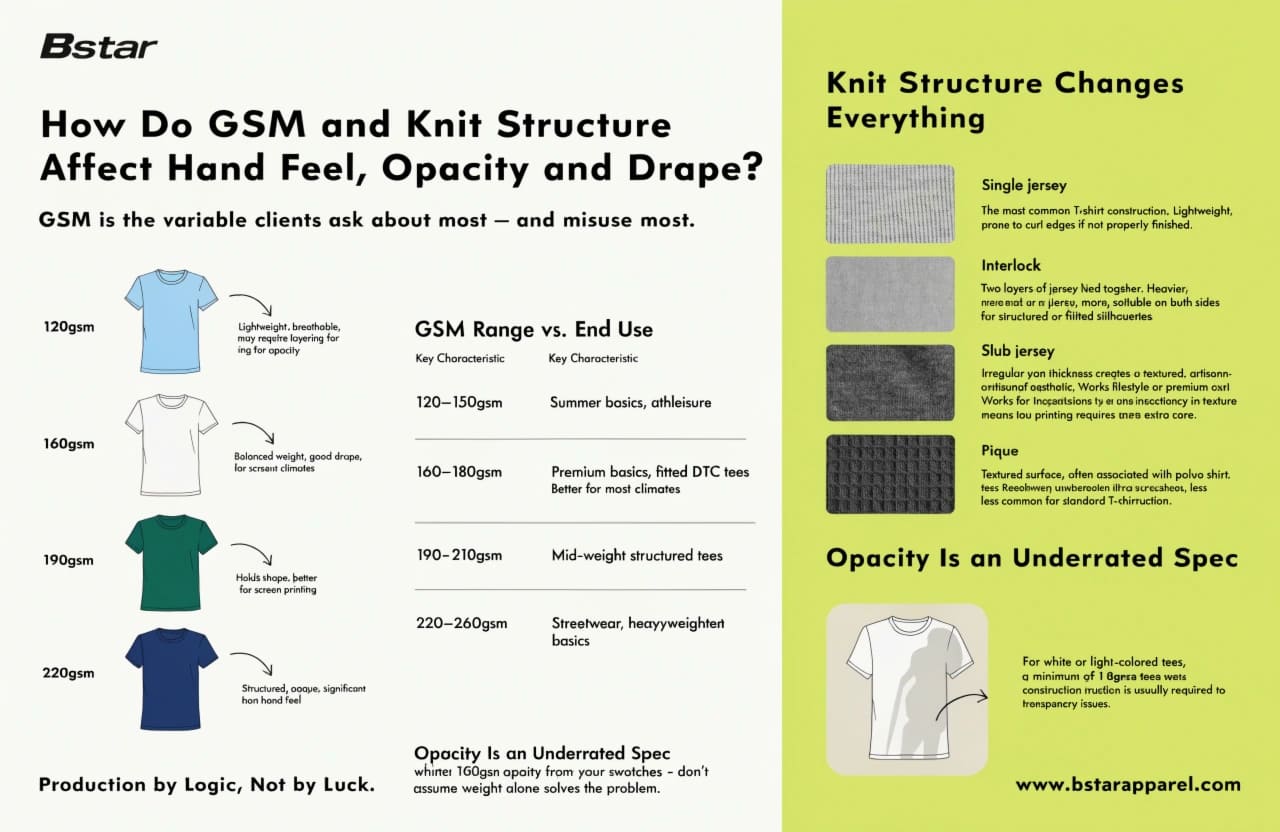
Construction note: interlock is a double-knit structure. No GSM threshold guarantees opacity, breathability or printing performance; review the written criteria and actual samples below.
GSM as a Fit-for-Purpose Variable
We frame GSM as a tool, not a ranking. These are illustrative starting bands for swatch discussion; they are not industry approval limits or evidence that a fabric is breathable, opaque or print-ready. For the measurement itself, see how fabric GSM is assessed.
| Example GSM Range | Direction to Explore | What Still Needs Checking |
|---|---|---|
| 120–150gsm | Lightweight summer or layering tees | Opacity, handling, comfort and decoration on the actual fabric |
| 160–180gsm | A balanced starting point for everyday or fitted tees | Drape, fit, dimensional stability and intended care |
| 190–210gsm | More substantial everyday or structured directions | Actual stiffness, surface, comfort and print results |
| 220–260gsm | Heavyweight or boxier streetwear directions | Whether the weight and drape suit the wearer and season |
A 220gsm fabric may suit a boxy streetwear brief and feel too substantial for a lightweight fitted summer tee. The weight has not changed; the intended product has. Composition, construction and finish can still make two 220gsm fabrics feel very different.
Knit Structure Changes Everything
- Single jersey: a common T-shirt construction. Cut edges tend to curl because of the loop structure; assess handling and the finished edge rather than treating any curl as a defect.
- Interlock: a double-knit structure with intermeshing stitch systems, rather than two separate jersey fabrics joined together. Compare its face, back, stability and drape against the brief.1
- Slub jersey: variation in yarn thickness creates a textured surface. It can suit a casual visual direction; approve the texture and decoration together rather than treating intentional slub as random inconsistency.
- Piqué: a textured construction often associated with polo shirts. If used for a T-shirt, compare its surface, drape and decoration behavior; the construction name alone does not establish breathability.
Opacity Is an Underrated Spec
Brands frequently overlook opacity until they see through-shirt visibility in product photography or receive customer feedback. There is no universal GSM minimum that makes every white tee opaque. Compare the actual color, construction and finish under consistent lighting and intended stretch, then check a garment sample on the intended body or reference. A backlit swatch is a useful screening comparison, not a substitute for the final appearance review.
How Should You Match T-Shirt Fabric with Printing and Embroidery Requirements?
Fabric selection doesn’t happen in isolation from decoration. The fabric you choose has a direct impact on how printing and embroidery perform — and on its appearance after the agreed wash routine.
Different decoration methods have genuine technical compatibility requirements. Choosing them separately can leave brands with cracked prints, puckered embroidery or inconsistent color after washing.
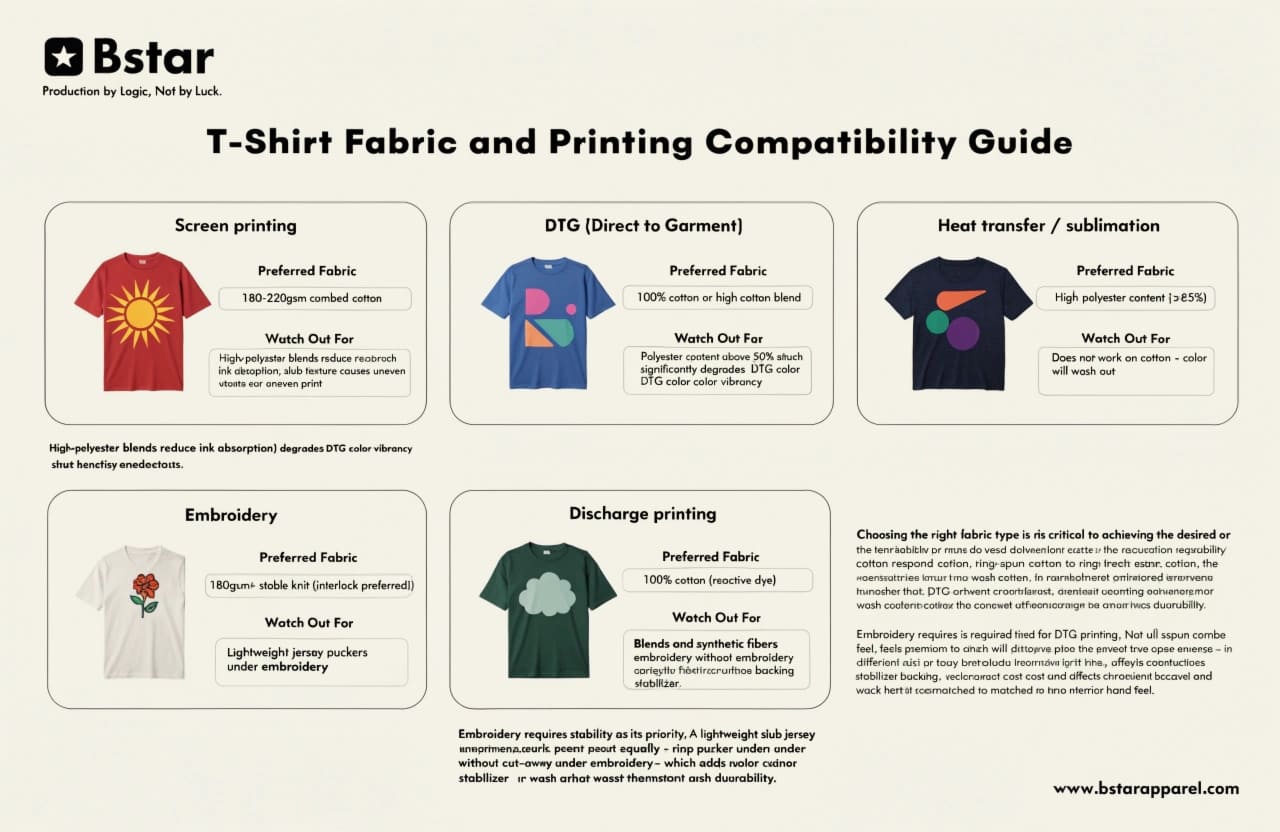
Process correction: heat-transfer films/DTF and dye sublimation are separate routes. The pictured 50% DTG threshold and fixed weight requirements are not universal specifications; use the revised table below.
Decoration Method × Fabric Compatibility
| Decoration Method | Fabric Direction to Review | Watch Out For |
|---|---|---|
| Screen printing | Surface and composition compatible with the selected ink system | Texture, cure conditions, stretch and dye migration; no universal GSM requirement |
| DTG (Direct to Garment) | Fabrics supported by the actual printer, ink and pre-treatment system | Cotton and polyester routes differ; there is no universal 50% polyester failure threshold |
| Heat-transfer film or DTF | Substrates supported by the specified transfer product | Adhesion, heat sensitivity, stretch, dye migration and interior hand feel |
| Dye sublimation | Usually white or light polyester fabric, or a specifically compatible substrate system | Do not confuse direct dye sublimation with transfer products designed to bond onto cotton |
| Embroidery | Fabric and backing suited to the design, stitch density and placement | Puckering, needle damage, distortion and the feel of the backing |
| Discharge printing | A dyed fabric tested as dischargeable with the intended ink | Cotton content or a “reactive dye” description alone does not guarantee the result |
Printing compatibility is system-specific: Epson documents cotton and polyester pre-treatment requirements for a named DTG system, while Siser lists cotton and polyester compatibility for a named heat-transfer film.6 Epson’s sublimation guidance is a separate process reference.7 Use these process examples to ask the supplier which actual method and material their quote covers.
Fabric Pre-Treatment Affects Print Quality
For DTG, follow the specific printer, ink and pre-treatment instructions; requirements can differ with fiber, garment color and the use of white ink. Do not assume every cotton job needs the same treatment or that “combed ring-spun” guarantees an even print. In client consultations, we often see brands spec a fabric based on feel, then discover the DTG output is inconsistent because the yarn structure wasn’t matched to the pre-treatment process. Review the entire fabric-and-print combination on a sample.6
For embroidery programs, fabric stability is the priority. A lightweight slub jersey may need backing and design adjustments to control puckering under a chest logo. Ask for the actual stitch-out: backing choice, stitch density and placement affect cost and the feel against the body.
What Should Brands Check in Fabric Swatches and Wash-Test Samples Before Approval?
A digital description cannot complete fabric approval. Physical swatches and wash-test samples show whether the selected option meets the brief before bulk commitments are made.
In our experience, two recurring scenarios behind rework are a brand approving fabric from a digital description, or reviewing it in its original condition without checking it after washing.
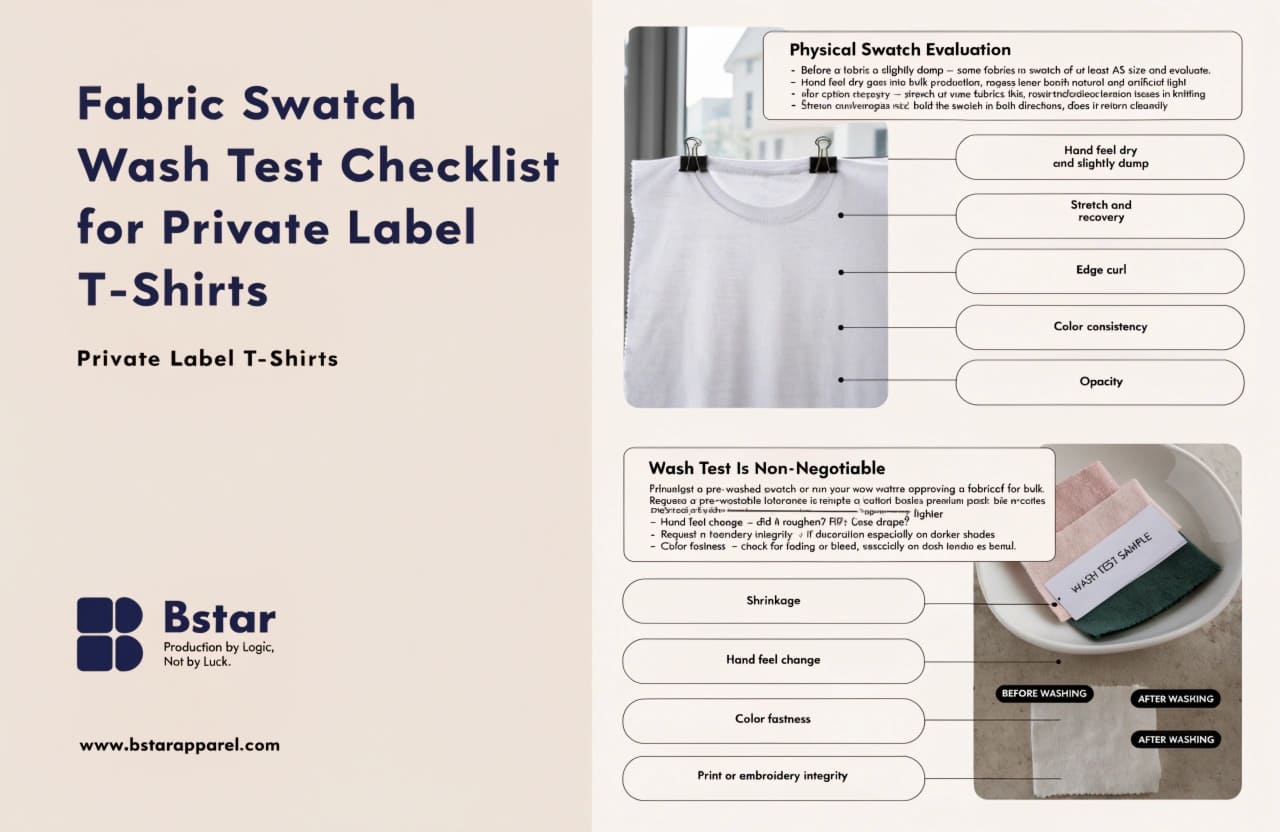
Workflow illustration: the pictured samples are not reported BSTAR before-and-after test results. Sample size, wash conditions, cycle count and acceptance limits must be agreed for the project.
What to Evaluate in a Physical Swatch
For an initial discussion, an A5-size swatch can be useful for handle and color. Agree the larger yardage, specimens and garment samples needed for washing, decoration and measurements; A5 is not a universal test-specimen size. Start the swatch review with:
- Hand feel dry and, where relevant, slightly damp — compare samples consistently; this is a handle check, not proof of performance during perspiration
- Stretch and recovery — compare both fabric directions consistently; a hand stretch is screening, not a quantified recovery test
- Edge curl — note whether handling and the intended construction are affected; curl alone does not identify a knitting-tension fault
- Color consistency — compare against an agreed reference under defined lighting; casual daylight/indoor checks do not replace a specified color assessment
- Opacity — compare under the same lighting, backing and intended stretch, especially for white and light colors
The Wash Test Is Non-Negotiable
Request matched unwashed and washed samples, or agree a test using your intended care routine. Use a garment sample as well as fabric yardage where fit, seams, neck shape or decoration matters. Record the washing and drying conditions, cycle count and measurement method. ISO 6330 covers domestic washing/drying procedures, while ISO 5077 addresses dimensional change; these method scopes do not establish one universal T-shirt pass limit.8 Review:
- Dimensional change: measure the agreed points before and after washing, in both relevant directions. Keep growth and shrinkage distinct and compare with the buyer-approved limits
- Hand feel and appearance: did it roughen, pill or lose the intended drape? Also review neck shape and side-seam twist on the garment
- Color change and transfer: look for fading or bleed, especially on darker shades. Use a specified colorfastness method if the order requires a graded result
- Print or embroidery integrity: if decoration samples are available, wash them too
Brands that skip this step can discover dimensional or appearance issues only after bulk production, when correction is harder. Responsibility for the resulting costs depends on the agreed specification, approvals and order terms. Define the sampling and prototyping scope before making the fabric or garment approval final.
Certification Requirements Start Before Swatch Approval
Raise certification and sourcing requirements in the brief, then check the proposed material’s supporting documents before approval. For GOTS, distinguish certified fabric sourcing from an intended GOTS-labeled finished garment and verify the applicable processing and trading chain.3 For OEKO-TEX® STANDARD 100, check the certificate holder, validity, certified article and relevant components; a fabric certificate does not automatically cover the finished decorated tee.9
For Better Cotton Initiative (BCI) requirements, identify the chain-of-custody model and permitted claim. Mass Balance is volume accounting and does not establish physical traceability of the particular cotton in a T-shirt; do not treat it as an organic-fabric certificate.10 Agree the route early rather than assuming any missing claim can be added after production.
Keep an approval record with the swatch reference, supplier/material identity, composition and construction, agreed weight, color and finish, wash/decoration review, documents, approval date and open points. This connects the chosen fabric to what the manufacturer is actually asked to produce.
Frequently Asked Questions
What is the best GSM for a premium private label T-shirt?
There is no single best GSM. The 160–200gsm area can be one starting range for comparing everyday tees, while a heavier or lighter option may better suit a different fit and season. Treat those numbers as examples: review fiber, construction, finish, opacity and the washed garment together. A retail price or “premium” label does not determine a required weight.
Does GOTS certification apply to the fabric or the finished garment?
GOTS can cover certified textile materials and products within an approved processing and trading chain. A GOTS-certified fabric does not, by itself, make every downstream finished garment eligible for a GOTS label. Check the relevant operators, scopes and product documentation for the intended claim; do not rely only on a hangtag or a supplier’s general certificate.3
Can I use the same fabric for both screen printing and DTG printing?
Potentially, but approve each fabric-and-decoration combination. Cotton may be a useful starting substrate, yet the ink system, finish, pre-treatment, surface and curing matter. Test the actual artwork and fabric for each method; a GSM minimum or “combed ring-spun” description alone does not make the two results interchangeable.6
How many wash cycles should I test before approving a fabric?
Agree the cycle count with the buyer and test provider for the intended claim, care routine and approval stage. A few initial cycles may be useful screening, but neither three cycles nor five to ten cycles is a universal approval rule or proof of lifetime durability. Record results at agreed checkpoints and use appropriate methods when a quantified pilling, colorfastness or dimensional result is required.8
What’s the difference between OEKO-TEX® Standard 100 and GOTS?
OEKO-TEX® STANDARD 100 concerns testing and certification of textile articles for harmful substances within its defined scope and limits; it does not establish organic content.9 GOTS addresses organic-textile processing and supply-chain requirements.3 The two schemes answer different procurement questions, and the actual article, holder, scope and permitted claim must be checked.
Conclusion
Choosing fabric for private label T-shirts is an important product-development decision and an easy one to rush. The brands that get it right start with customer profile and budget, work through fiber composition and GSM with a clear end-use in mind, match fabric to their decoration method, and validate the choice through physical swatches and wash tests before bulk approval.
The wrong fabric spec doesn’t just feel off. It can create rework, unsupported claims and a product that misses the intended price position. BSTAR is the brand of Zhongshan BEST Garments Co., Ltd., based in Xiaolan, Zhongshan, China. If you are preparing a private label T-shirt line, discuss the fabric brief with our team. We can review the material direction, sampling scope and any required supplier documentation before you commit to a production specification.
-
National Cotton Council, Yarn Production. Describes combing and spinning stages. Cotton Incorporated’s Single & Double Knits explains interlock construction. These process and construction names do not form a universal price or performance ladder. ↩ ↩
-
Supima, FAQ and license information. Explains Supima’s relationship to American-grown Pima cotton and trademark authorization; it is not a generic label for all Pima. ↩
-
Global Standard, GOTS key features. Verify certified operators, processing/trading scope and the documentation needed for the intended material or finished-product claim. This source is not evidence that BSTAR’s factory is GOTS-certified. ↩ ↩ ↩ ↩
-
Properties, Production, and Recycling of Regenerated Cellulose Fibers: Special Medical Applications, research review. Background on regenerated cellulosic fibers; not a controlled comparison of T-shirt softness, shrinkage or long-term wash durability. ↩
-
Lenzing, TENCEL™ Modal. Manufacturer information on its branded wood-based regenerated cellulose fibers. Brand-specific sourcing and softness descriptions do not establish the performance or environmental claims of every modal blend. ↩
-
Epson, required equipment and pre-treatment for a specified DTG system, and Siser, EasyWeed heat-transfer material. These product-specific examples distinguish DTG requirements from transfer-material compatibility; they are not universal fabric or polyester-percentage rules. ↩ ↩ ↩
-
Epson, sublimation process and fabric guidance. Product/process guidance for polyester or compatible substrates, distinct from heat-transfer films that can bond to cotton. ↩
-
ISO, ISO 6330:2021 — Domestic washing and drying procedures for textile testing and ISO 5077:2007 — Determination of dimensional change in washing and drying. Public scope descriptions establish the method purposes; this guide does not reproduce the standards or prescribe a universal shrinkage tolerance or cycle count. ↩ ↩
-
OEKO-TEX®, STANDARD 100. Textile-article certification for harmful substances within defined limits and scope. Check the actual certificate holder, article and validity; a fabric certificate does not automatically cover all finished-garment components and decoration. ↩ ↩
-
Better Cotton Initiative, Chain of Custody and Mass Balance model. Distinguishes physical traceable routes from volume-accounting arrangements; verify the applicable model and permitted claim. ↩

[…] fabric decisions that are still open, use the private-label T-shirt fabric guide before treating a PP sample as the final material […]
[…] new pattern or sample, then confirm the revised version by email. If the material is undecided, our private-label T-shirt fabric guide provides a starting point on composition, weight and knit behavior; check the final fabric and […]