Adaptive Underwear: Can Your Factory Actually Build It?
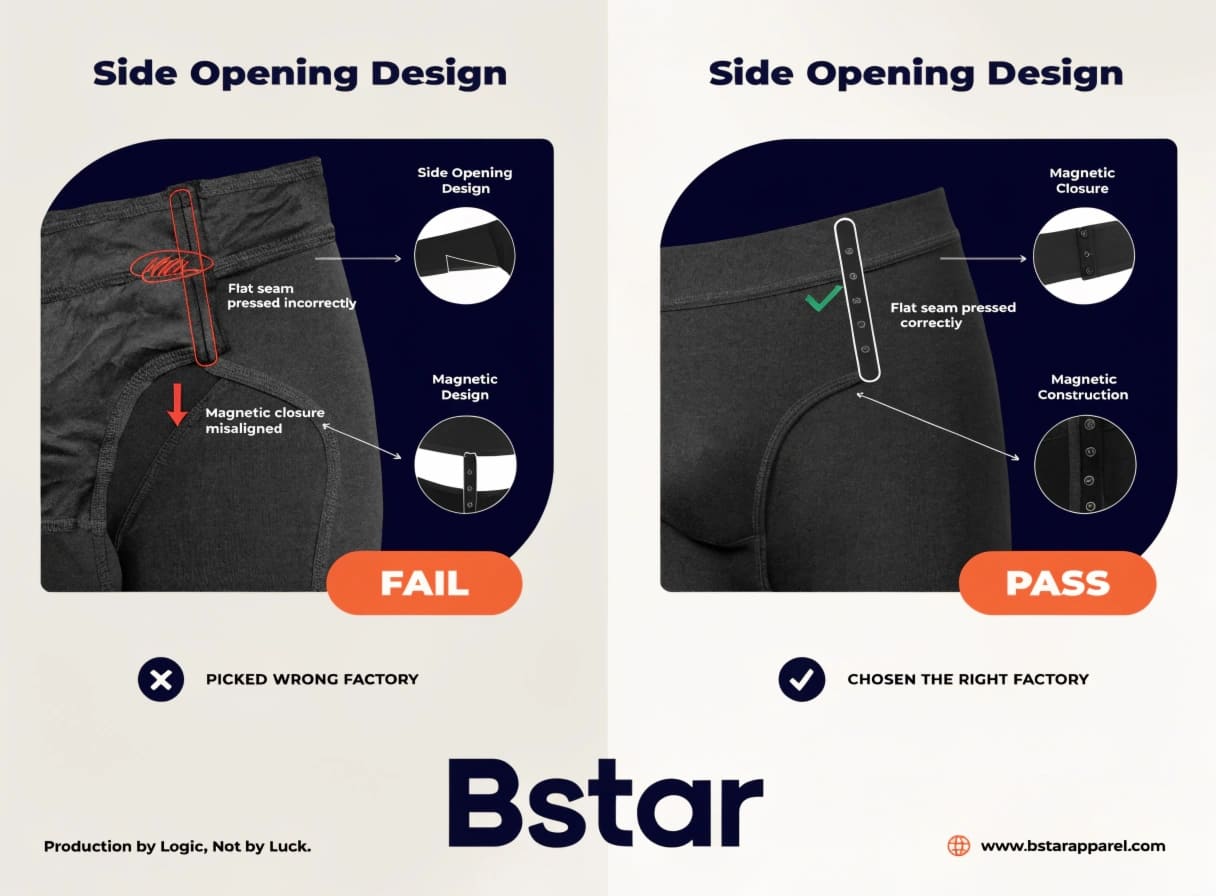
Launching an adaptive underwear line sounds straightforward — until your first samples come back and nothing works. The closures fail, the seams press wrong, and the opening sits in the wrong place.
Adaptive underwear fails at the factory level, not the design level. Features like magnetic closures, side openings, and flat-seam construction require a factory that can propose structural alternatives mid-sampling — not just cut what’s on your tech pack. Picking the wrong factory is the most expensive mistake you can make.
Most brands arrive at this category with a solid design brief and a clear user in mind. What they don’t have is a factory that knows what to do when round-one samples fail functional testing. That’s the real problem. And it’s what this article is about — what actually happens on the production side when you try to build adaptive underwear, and how to avoid the common traps.
Innovative Closure Systems: Can Your Factory Source and Integrate Them?
You spec magnetic closures on your tech pack. Your factory says yes. Then your first sample arrives and the magnets are glued, not anchored — and they come off after three wears1.
Magnetic buttons, hook-and-loop tape, and one-handed zipper pulls are not decoration. They require precise placement, load-bearing attachment methods, and compatibility with the base knit. A factory without experience in functional hardware will treat them like trims. That’s when samples fail.
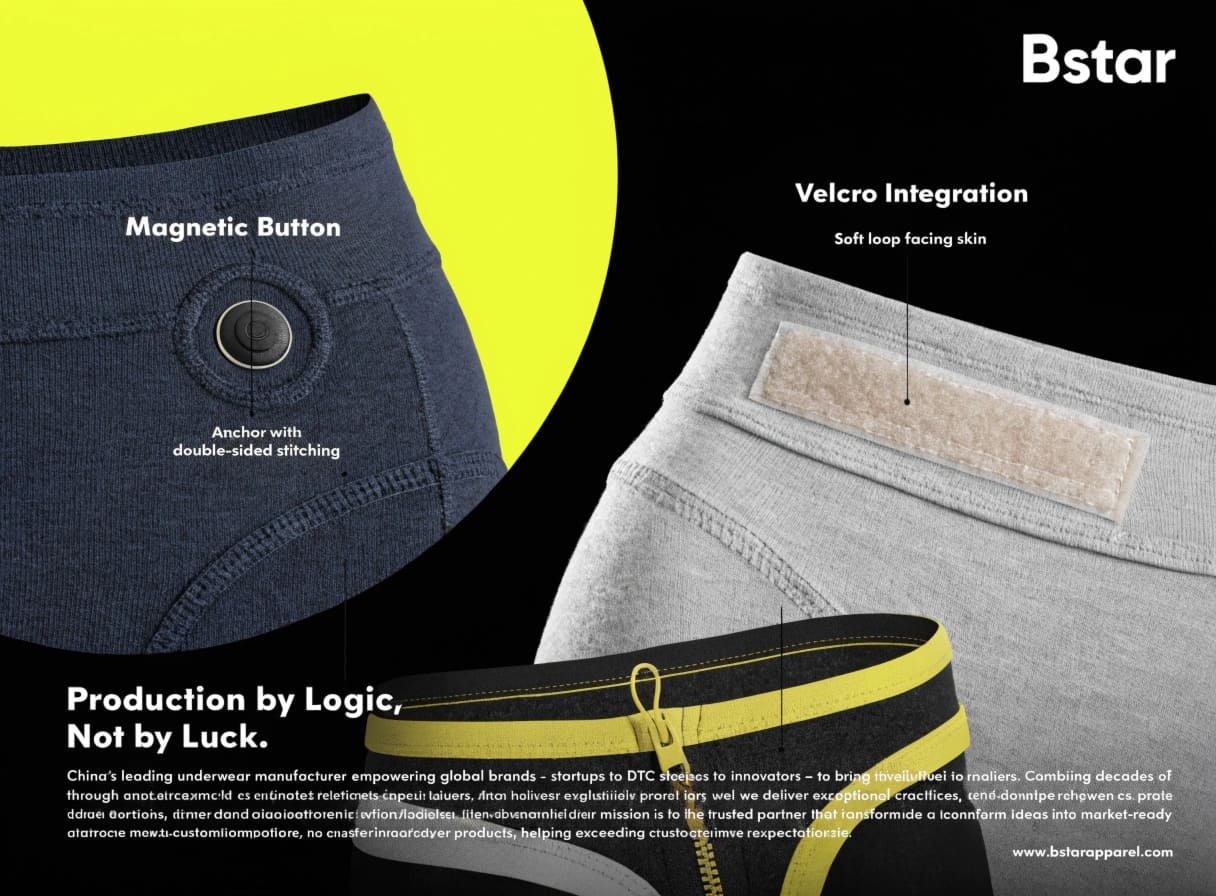
When a client came to us with a design for magnetic-close underwear targeting users with limited hand grip, the first conversation wasn’t about aesthetics. It was about how the magnets would be anchored through a stretch knit without creating a hard pressure point on the skin underneath. That’s a structural decision — not a trim decision.
What Closure Selection Actually Requires at the Factory Level
Here’s what your factory needs to work through before a single sample is cut:
| Closure Type | Key Manufacturing Challenge | What to Ask Your Factory |
|---|---|---|
| Magnetic buttons | Anchoring through stretch fabric without stiffening the panel | "How do you reinforce the attachment zone?" |
| Velcro / hook-and-loop | Loop-side softness, placement away from skin contact | "Which side faces skin? How is edge-finishing handled?" |
| One-handed zipper pulls | Pull tab size, zipper weight relative to knit stretch | "Have you integrated zippers into underwear-weight knits before?" |
The factories that struggle here are the ones that source closures last. The ones that work ask about closure mechanics in the first sampling conversation — because closure type affects pattern structure, not just finishing.
Ergonomic Pattern Grading: Side Openings, Grip Loops, and Extended Rises for Wheelchair Users
Standard underwear grading assumes standing posture. Wheelchair users spend most of their day seated2. Those two realities produce completely different fit requirements — and most factories are not grading for the second one.
For wheelchair users, side-opening panels, extended back rises, and grip loops are functional necessities3. Each one changes how the pattern is graded across sizes. A factory without structural sampling experience will miss these relationships and produce samples that fit a mannequin but not a seated body.
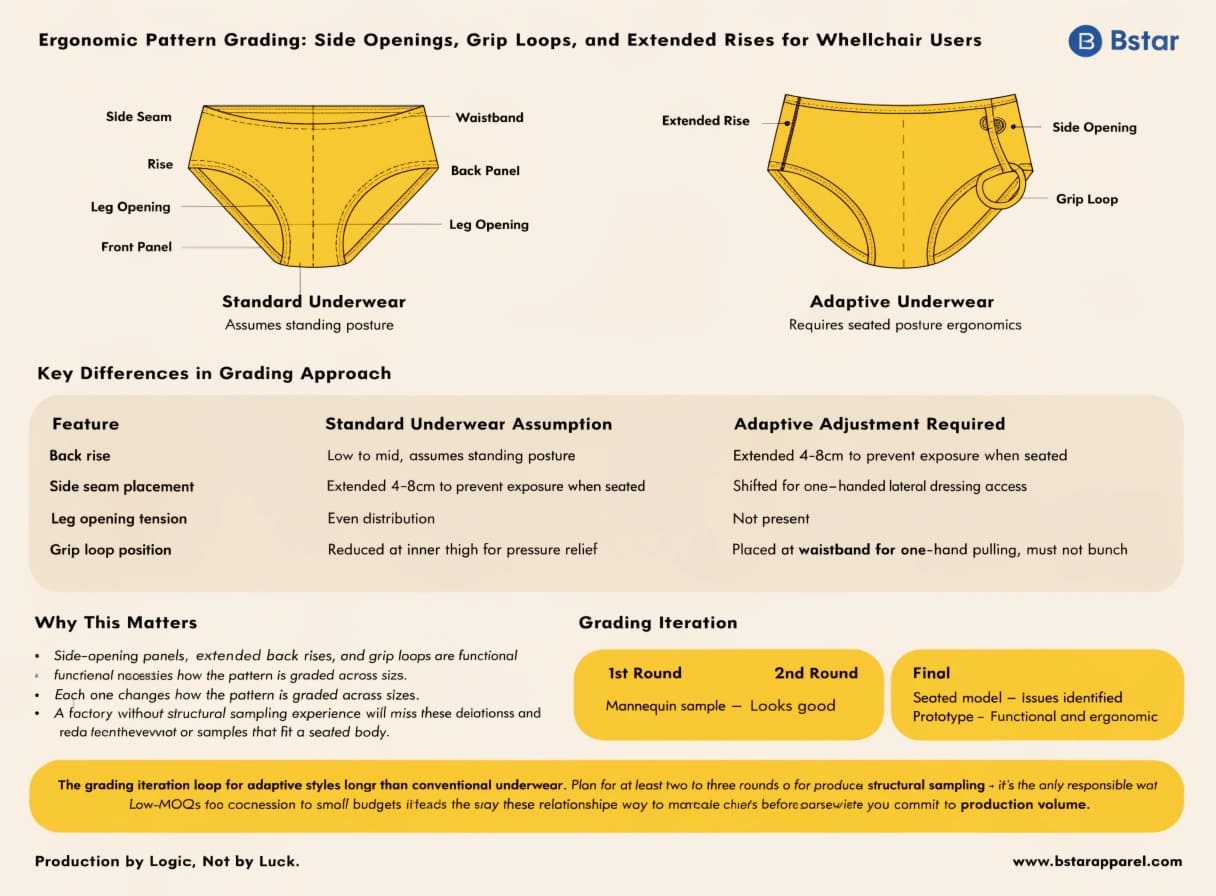
We had a client developing side-open underwear for post-surgical users. Their tech pack showed the opening placement on a standing body block. Our sampling team’s first question was: "Is this being worn seated or standing during dressing?" That one question changed the opening position by about four centimeters and altered the panel seam routing entirely.
What Changes When You Grade for Seated Posture
This is where brands most often underestimate scope. Pattern grading for adaptive underwear isn’t just sizing up or down — it’s adjusting the structural relationships between panels.
| Feature | Standard Underwear Assumption | Adaptive Adjustment Required |
|---|---|---|
| Back rise | Low to mid, assumes standing | Extended 4–8cm to prevent exposure when seated4 |
| Side seam placement | Centered for standing symmetry | Shifted for one-handed lateral dressing access |
| Leg opening tension | Even distribution | Reduced at inner thigh for pressure relief |
| Grip loop position | Not present | Placed at waistband for one-hand pulling, must not bunch |
The grading iteration loop for adaptive styles is longer than conventional underwear. Plan for at least two to three rounds of structural sampling before you reach a wearable prototype5. Low-MOQ sampling isn’t a concession to small budgets — it’s the only responsible way to validate these decisions before you commit to production volume.
Sensory-Friendly Material Selection: Flat Seams, Tagless Designs, and What Certification Doesn’t Tell You
Brands building for sensory-sensitive users often come to us with OEKO-TEX or GOTS as their material requirement. That’s a good starting point. But it’s not enough on its own.
OEKO-TEX and GOTS certification confirm that materials are free from harmful substances6. They don’t confirm seam pressure behavior, elastic tension by body zone, or dye lot consistency across production runs — all of which matter more to sensory-sensitive users than the certification label alone.
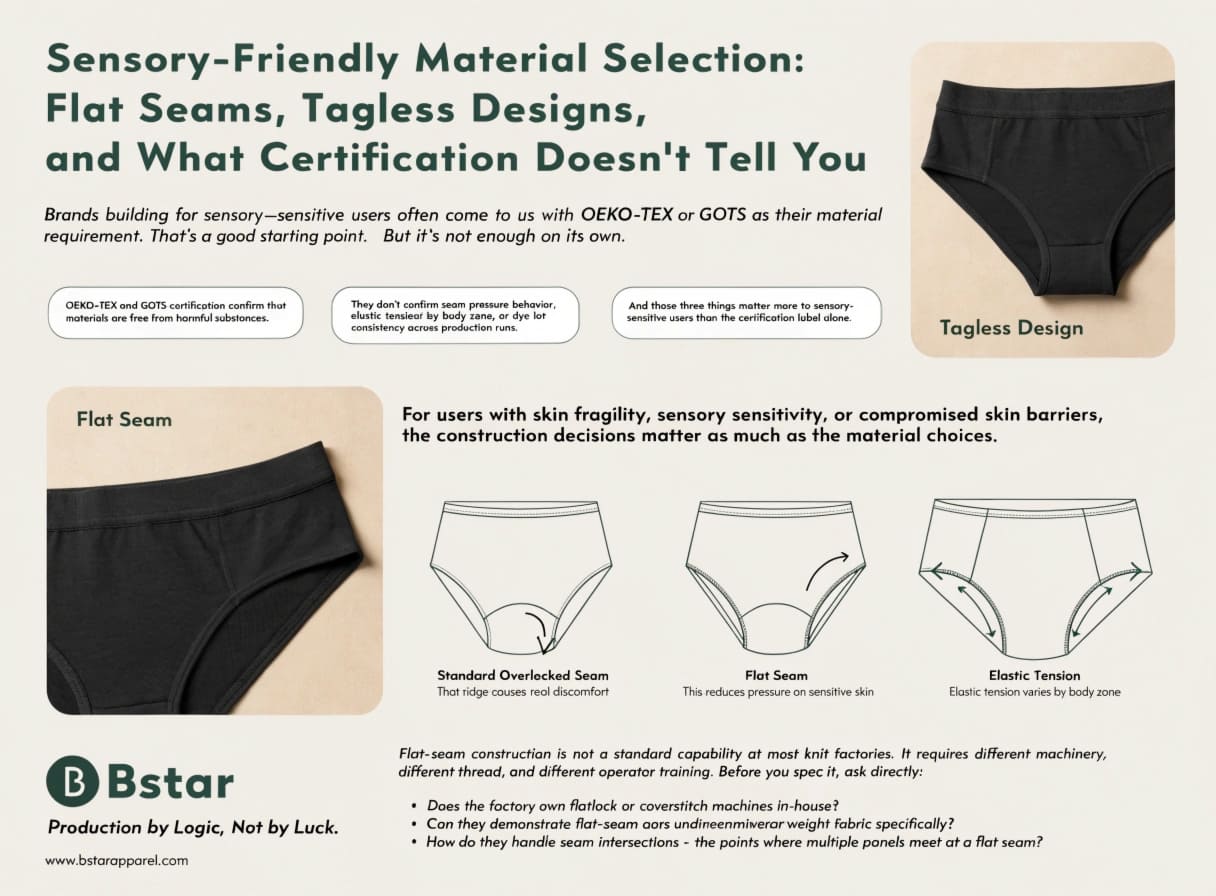
For users with skin fragility, sensory sensitivity, or compromised skin barriers7, the construction decisions matter as much as the material choices. A certified fabric sewn with a standard overlocked seam still creates a ridge. That ridge causes real discomfort for real users.
Flat-Seam Construction: What It Requires at the Factory Level
Flat-seam construction is not a standard capability at most knit factories8. It requires different machinery, different thread, and different operator training. Before you spec it, ask directly:
- Does the factory own flatlock or coverstitch machines in-house?
- Can they demonstrate flat-seam samples on underwear-weight fabric specifically?
- How do they handle seam intersections — the points where multiple panels meet at a flat seam?
Seam intersections are where most flat-seam samples fail. A factory that can run a flat seam down a side panel but can’t clean up the gusset-to-front-panel junction hasn’t actually solved the problem.
For tagless designs, the same logic applies. Heat-transfer labels need to be applied at the right temperature and pressure or they peel. Printed labels need to be tested for wash durability and ink sensitivity. These are production decisions, not just design decisions — and your factory needs to have tested them before your product launch.
Inclusive Manufacturing Standards: Dignity, Comfort, and Mainstream Aesthetics in One Product
Adaptive underwear has a visibility problem. A lot of what’s currently on the market looks medical9. Users don’t want medical-looking underwear — they want underwear that looks like underwear10.
Building adaptive function into a product that still looks mainstream requires manufacturing discipline, not just design intent. Functional features need to be integrated into the garment structure, not added on top of it. That’s a sampling and construction challenge, not a branding challenge.
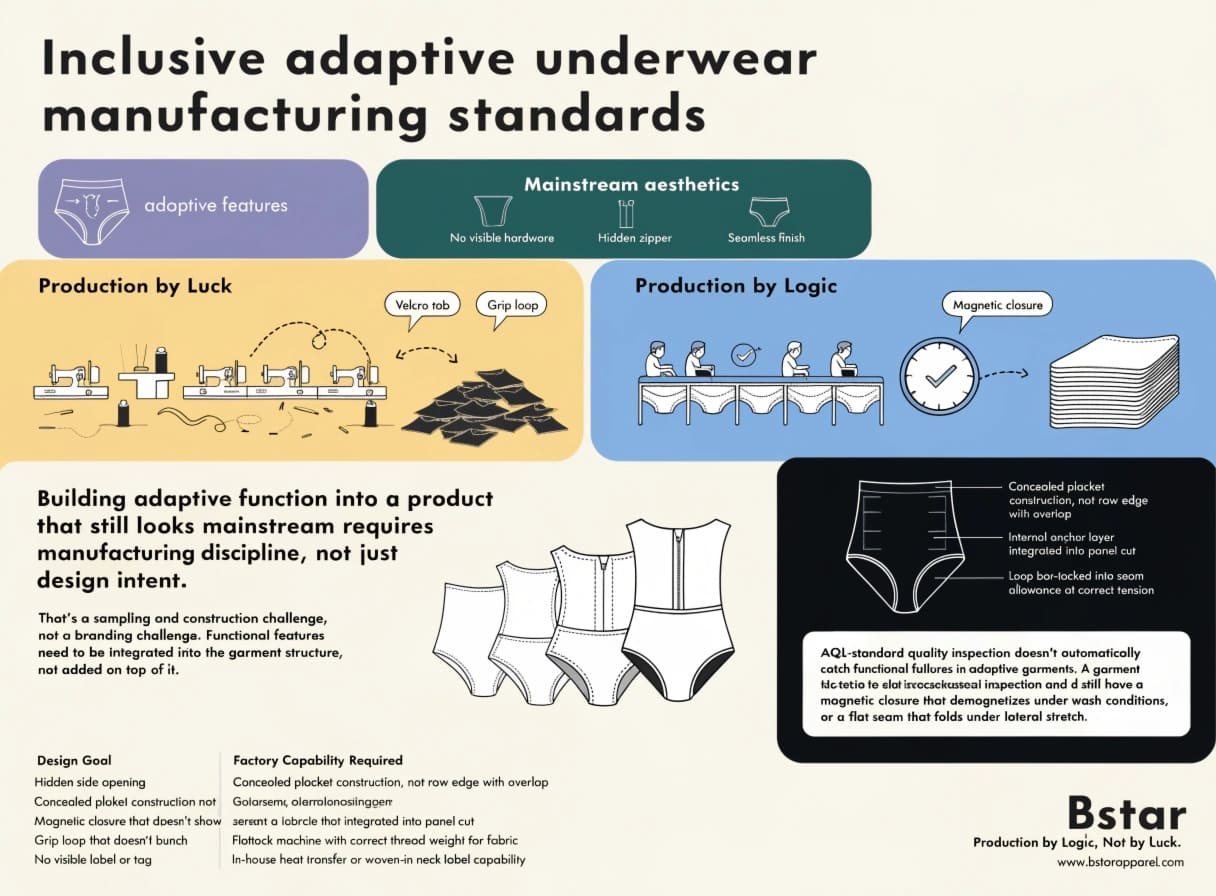
This is where production line adaptations matter most. Factories that treat adaptive features as add-ons — a velcro tab here, a loop sewn on after — produce garments that look like afterthoughts. Factories that build functional features into the panel structure from the start produce garments that look intentional.
What "Mainstream Aesthetics" Requires From a Factory
| Design Goal | Factory Capability Required |
|---|---|
| Hidden side opening | Concealed placket construction, not raw edge with overlap |
| Magnetic closure that doesn’t show | Internal anchor layer integrated into panel cut |
| Grip loop that doesn’t bunch | Loop bar-tacked into seam allowance at correct tension |
| Flat seam that doesn’t add visible bulk | Flatlock machine with correct thread weight for fabric |
| No visible label or tag | In-house heat transfer or woven-in neck label capability |
AQL-standard quality inspection doesn’t automatically catch functional failures in adaptive garments11. A garment can pass a standard visual inspection and still have a magnetic closure that demagnetizes under wash conditions12, or a flat seam that folds under lateral stretch. Your factory needs to know what functional tests to run — and that means they need to have built adaptive garments before, not just read a spec sheet.
Conclusion
Adaptive underwear is a construction problem first. The factory you choose determines whether your design ever becomes a product that actually works for the people it’s meant to serve.
-
"Magnets 101: Choosing Magnetic Closures for Sewn …", https://www.madeapparelservices.com/blog/magnets-101-a-designers-guide-to-using-magnetic-closures-in-sewn-products?srsltid=AfmBOop9omV3gJzR8Tf_M70hiWgBoutq_v13JuAur6FM3AHn-Emyorl5. Studies on textile hardware attachment demonstrate that adhesive bonds on elastic substrates degrade significantly under cyclic mechanical loading and repeated laundering, with mechanical anchoring methods showing substantially greater retention strength. Evidence role: mechanism; source type: research. Supports: Adhesive-only attachment of hardware to stretch knit fabrics is insufficient for load-bearing applications subject to repeated mechanical stress and laundering. Scope note: Direct peer-reviewed data on consumer-use failure rates for glued magnetic closures specifically on underwear-weight knits may be limited; general textile hardware durability literature provides contextual support. ↩
-
"Everyday sitting behavior of full-time wheelchair users", https://pubmed.ncbi.nlm.nih.gov/27898157/. Research on activity patterns among wheelchair users indicates that individuals spend the majority of waking hours in a seated position, a postural reality that fundamentally differs from the standing-posture assumptions embedded in standard garment grading systems. Evidence role: statistic; source type: research. Supports: Wheelchair users spend a substantial proportion of daily hours in a seated position, justifying garment design based on seated rather than standing body posture. Scope note: Seated time varies by wheelchair type, disability category, and individual activity level; aggregate statistics may not reflect the full range of user experience. ↩
-
"Adaptive Fashion – Bryce Lab", https://labs.icahn.mssm.edu/brycelab/adaptive-fashion/. Occupational therapy literature on adaptive dressing identifies side-opening closures, extended posterior rise, and loop-based dressing aids as functional design elements that reduce the physical demands of lower-body dressing for individuals with limited hand function or mobility impairments. Evidence role: expert_consensus; source type: research. Supports: Occupational therapy and adaptive design literature identifies side openings, extended back rises, and dressing aids such as grip loops as evidence-based design features that support independent dressing for wheelchair users. Scope note: Specific design parameters such as exact opening dimensions or loop placement may vary by individual functional ability; published guidelines provide general principles rather than universal specifications. ↩
-
"Designing a Smart Garment for Dynamic Sitting Reminders", https://pmc.ncbi.nlm.nih.gov/articles/PMC12157298/. Ergonomic studies of seated body posture document posterior pelvic tilt and increased lumbar-to-waistband distance in wheelchair users compared to standing posture, supporting the need for extended back rise dimensions in adaptive garment design. Evidence role: general_support; source type: research. Supports: Seated posture in wheelchair users creates measurable changes in torso-to-hip geometry that require increased back rise in lower-body garments to maintain coverage and comfort. Scope note: The specific 4–8 cm range cited in the article may reflect manufacturer practice rather than a formally validated clinical standard; published research may report different ranges depending on measurement methodology. ↩
-
"[PDF] identifying the gap between adaptive clothing consumers – UDSpace", https://udspace.udel.edu/bitstreams/0ecb6525-dbed-4569-ab17-d2c76511018b/download. Product development literature in apparel engineering indicates that garments with integrated functional hardware or specialized fit requirements for non-standard body postures require additional prototype iterations compared to conventional styles, as each structural modification introduces new fit and performance variables requiring validation. Evidence role: general_support; source type: research. Supports: Complex or specialized garment categories with functional performance requirements typically require more prototype iterations than standard apparel before achieving a production-ready sample. Scope note: The specific figure of two to three rounds reflects practitioner experience as stated in the article; published research on adaptive garment development cycle lengths is limited, and actual iteration counts will vary by design complexity and factory experience. ↩
-
"Investıgatıon of seam performance and bıodegradabılıty of organıc …", https://pmc.ncbi.nlm.nih.gov/articles/PMC11799011/. According to the OEKO-TEX Association, OEKO-TEX Standard 100 tests textile articles for harmful substances including pesticides, heavy metals, and formaldehyde, but does not evaluate mechanical construction properties such as seam ridge height or elastic pressure distribution. Evidence role: definition; source type: institution. Supports: OEKO-TEX Standard 100 and GOTS certification criteria address chemical residue limits and organic fiber sourcing respectively, and do not include requirements for seam construction, elastic tension, or tactile performance. Scope note: Certification scope may be updated periodically; readers should consult current official OEKO-TEX and GOTS documentation for the most accurate description of covered criteria. ↩
-
"Effects of two different fabrics on skin barrier function under real …", https://pubmed.ncbi.nlm.nih.gov/27817985/. Research on sensory processing sensitivity and autism spectrum conditions documents that tactile hypersensitivity to clothing textures and seam pressure is a commonly reported source of discomfort, with seam placement and construction identified as significant factors in garment tolerance. Evidence role: expert_consensus; source type: research. Supports: Individuals with sensory processing differences or skin fragility conditions report heightened discomfort from tactile stimuli including clothing seams, supporting the functional importance of flat-seam construction for these populations. Scope note: Most published research focuses on autism spectrum populations; evidence for other sensory-sensitive or skin-fragile groups may be less systematically documented. ↩
-
"Flatlock Sewing Machine Definition, Key Features, Types, Popular …", https://www.youtube.com/watch?v=jFrglQeZknc&vl=en. Industry literature on apparel manufacturing equipment distinguishes flatlock and coverstitch machines as specialized assets associated with performance and activewear production, indicating that their presence is not universal across general knit garment facilities. Evidence role: general_support; source type: research. Supports: Flat-seam construction requires specialized flatlock or coverstitch machinery that represents a distinct capital investment beyond standard overlock equipment found in general knit factories. Scope note: Systematic data on the proportion of knit factories globally that own flat-seam machinery is not readily available in published research; the claim is supported by equipment classification literature rather than direct factory census data. ↩
-
"identifying the gap between adaptive clothing consumers", https://udspace.udel.edu/bitstreams/0ecb6525-dbed-4569-ab17-d2c76511018b/download. Consumer studies on adaptive clothing preferences have found that users with disabilities consistently identify aesthetic normalization — the desire for garments that resemble mainstream fashion rather than medical devices — as a primary unmet need in the adaptive apparel market. Evidence role: general_support; source type: research. Supports: Consumer research on adaptive apparel indicates that users frequently report dissatisfaction with the clinical or medical appearance of available adaptive clothing options and express preference for mainstream aesthetics. Scope note: Published consumer research specifically on adaptive underwear aesthetics is limited; broader adaptive clothing studies provide contextual support but may not fully represent the underwear category. ↩
-
"Adaptive Fashion: Access, Advocacy, and Occupational Therapy", https://soar.usa.edu/otdcapstonesfall2021/9/. Disability studies and inclusive design research indicate that aesthetic normalization is a significant factor in adaptive clothing acceptance, with users reporting that garments resembling medical equipment can reinforce stigma and negatively impact self-image, while mainstream-aesthetic adaptive designs support dignity and social inclusion. Evidence role: expert_consensus; source type: research. Supports: Research on disability identity and clothing preferences documents that many people with disabilities prioritize garments that reflect personal style and mainstream fashion norms, and that medical-appearing adaptive products can negatively affect dignity and self-perception. Scope note: Preferences vary across individuals, disability types, and cultural contexts; the desire for mainstream aesthetics, while widely reported, should not be assumed to be universal across all adaptive clothing users. ↩
-
"ISO 2859-1", https://chemistry.unt.edu/~tgolden/courses/iso2859-1.pdf. The AQL framework, as defined under ISO 2859 and applied in apparel quality control, establishes acceptance criteria based on defect classification and sampling frequency for visual and measurable attributes, and does not prescribe functional performance testing protocols for specialized hardware or construction features. Evidence role: definition; source type: institution. Supports: AQL inspection standards for apparel are based on statistical sampling of visual and dimensional defects and do not include functional performance tests such as magnetic retention strength or seam behavior under dynamic stretch. Scope note: Factories may supplement AQL inspection with product-specific functional tests; the absence of such tests from the AQL standard does not preclude their use, but they are not mandated by the standard itself. ↩
-
"Demagnetizing Neodymium Magnets | Physics Van | Illinois", https://van.physics.illinois.edu/ask/listing/42727. Materials science literature on permanent magnets indicates that neodymium and ferrite magnets are susceptible to partial demagnetization when exposed to temperatures approaching their Curie point, and that repeated thermal cycling in domestic laundering conditions can cumulatively reduce magnetic flux density. Evidence role: mechanism; source type: research. Supports: Exposure to elevated temperatures during laundering can reduce the magnetic strength of permanent magnets used in garment closures, particularly if magnets are not rated for thermal cycling. Scope note: The degree of demagnetization depends heavily on magnet grade, coating, and specific wash temperatures; not all garment magnets will demagnetize under standard cold-water laundering. ↩