

How to Find a Reliable Boxer Underwear Manufacturer in China: A Complete Guide for European & US Brands?
Finding a reliable boxer underwear manufacturer in China can feel risky when your brand is ready to launch, but you cannot afford late samples, weak elastic, unclear certifications, or poor fit. One wrong supplier can create refunds, inventory waste, and compliance delays. I wrote this guide to help you filter risk before you place your first order.
A reliable boxer underwear manufacturer in China should offer verified compliance documents, stable fabric sourcing, clear sampling workflows, transparent MOQ and pricing, AQL-based quality control, and responsive English communication. The best choice is not always the cheapest factory. It is the partner that can reduce landed-cost risk, protect product quality, and support repeat orders.
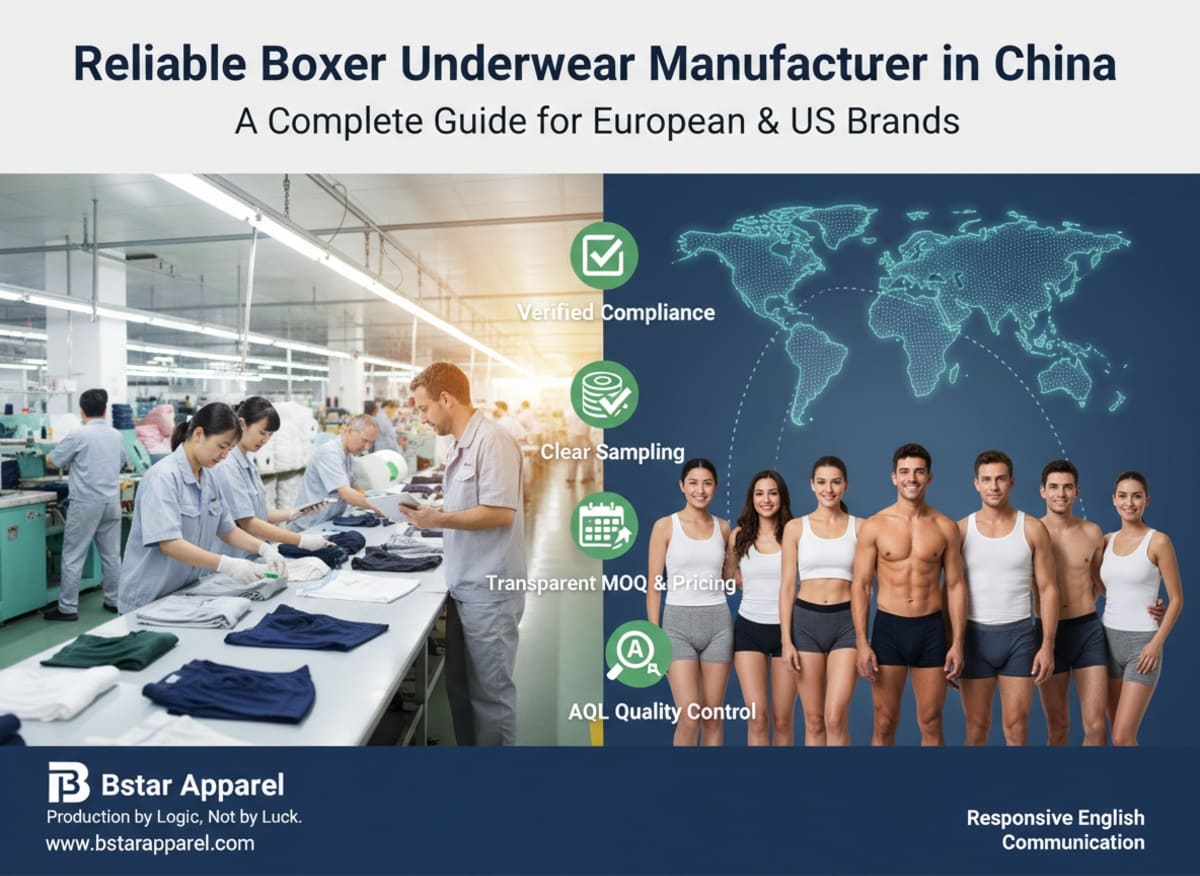
I work from the factory side at BSTAR in Zhongshan, Guangdong. In our daily conversations with European and US DTC underwear brands, I see the same sourcing questions appear again and again. The brands that move fastest usually check the right things early.
Trading Company vs. Direct Factory: How Can You Identify the Real Boxer Underwear Manufacturer in China?
A polished website can hide a weak production setup. That creates a real problem when you need technical fit, stable quality, and fast revisions. If you choose the wrong partner, you may lose control over cost, delivery, and accountability.
A direct boxer underwear manufacturer in China should be able to explain its production process, sampling capacity, equipment, QC checkpoints, and material sourcing clearly. You should ask who owns the factory floor, who manages patterns, who controls inspection, and whether you can verify production photos, videos, audits, or on-site visits.
What I Ask Buyers to Check First
When a buyer asks me, “Are you a factory or trading company?” I do not see that as a rude question. I see it as a necessary risk check. A real OEM/ODM partner should welcome that question.
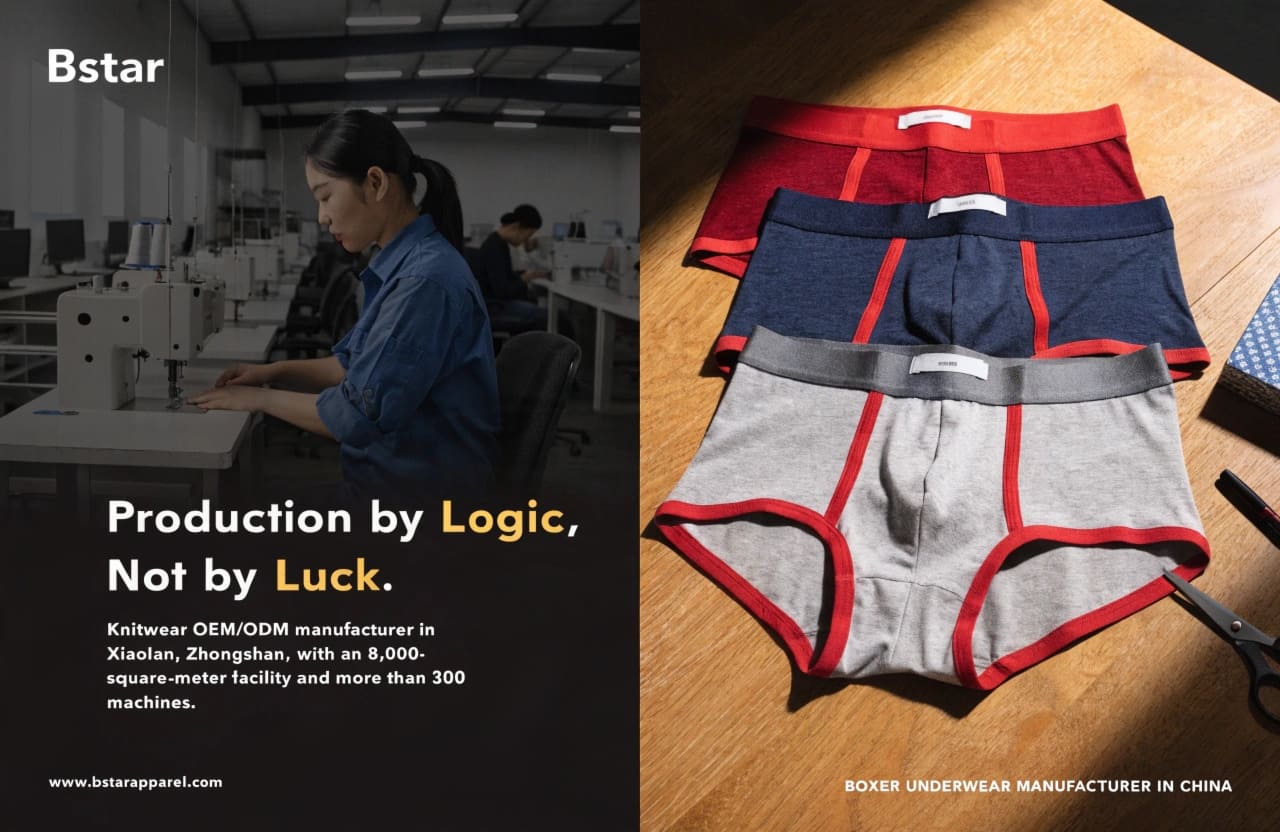
At BSTAR, we operate as a knitwear OEM/ODM manufacturer in Xiaolan, Zhongshan, with an 8,000-square-meter facility and 300+ machines. That matters because boxer underwear production is not only sewing. It includes pattern adjustment, fabric selection, waistband matching, cutting control, sewing consistency, inspection, packing, and export coordination.
Here is a simple comparison I suggest brands use:
| Evaluation Point | Trading Company | Direct Factory |
|---|---|---|
| Price transparency | Often limited | Usually clearer |
| Sample revisions | May be slower | Usually faster |
| QC accountability | Indirect | Direct |
| Fabric discussion | May depend on third parties | Closer to sourcing |
| Production visibility | Limited | Easier to verify |
Practical Verification Questions
I recommend asking these questions before paying sample fees:
- Can you show your cutting, sewing, inspection, and packing areas?
- Who makes the paper pattern and size grading?
- Can your merchandiser explain fabric GSM, shrinkage, and waistband options?
- Do you support small-batch development or only bulk orders?
- Can I review certification documents before sampling?
A real boxer underwear manufacturer in China should answer without becoming defensive. If the answer is vague, slow, or overly focused on “best price,” I would pause. The cheapest quote is often not the cheapest final result.
Essential Certifications: What Must a Boxer Underwear Manufacturer in China Help US & EU Brands Verify?
Compliance confusion can stop a product after you have already invested in samples and packaging. That is painful because the issue often appears late. If your fabric or factory documents are incomplete, your buyer, marketplace, or retailer may ask for rework.
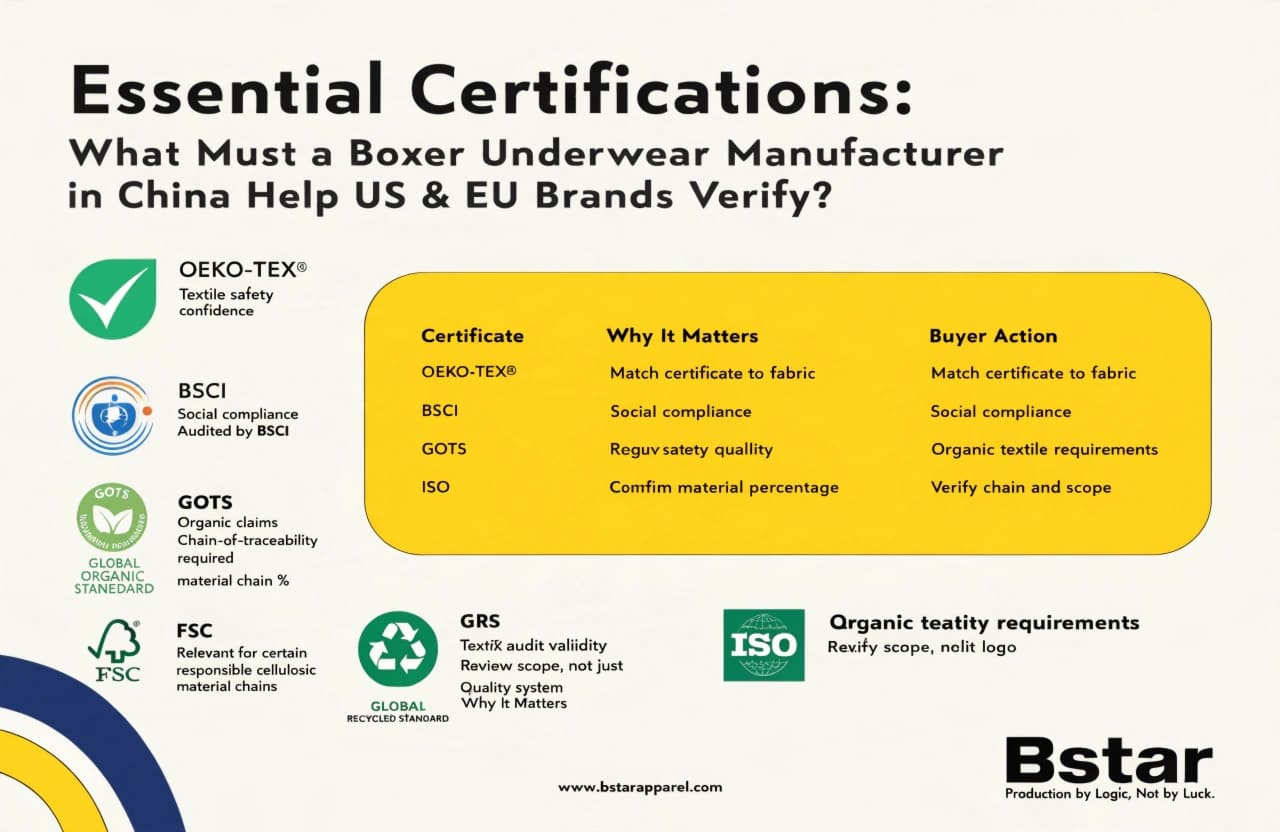
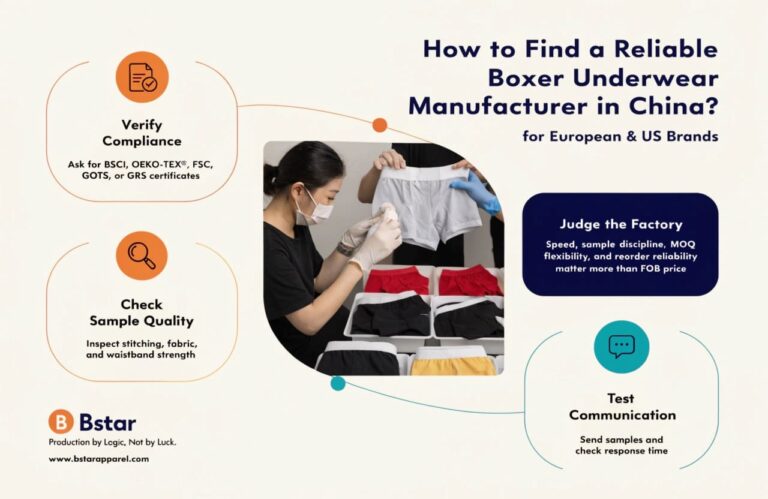
A qualified boxer underwear manufacturer in China should help you verify documents such as OEKO-TEX®, BSCI, ISO-related quality systems, and material-specific certificates like GOTS, GRS, or FSC where relevant. You should review actual certificates, scope, validity dates, issuer names, and whether the certified material matches your order.
Certificates Are Market Access Tools
I always remind new DTC founders that certifications are not decoration. For EU and US underwear brands, they often become market access requirements. A factory that cannot show documents early may create downstream cost later.
At BSTAR, we hold BSCI social responsibility certification, and we work with materials supported by documents such as OEKO-TEX®, GOTS, GRS, and FSC depending on the fiber and order requirement. I still tell buyers to verify every certificate. A responsible supplier should encourage that.
A certificate should answer this question: “Can this product enter my sales channel with less compliance risk?”
What to Verify Before Sampling
Use this checklist:
- BSCI: Social compliance audit status and validity.
- OEKO-TEX®: Chemical safety certification for textile materials.
- GOTS: Organic textile requirements, if you claim organic cotton.
- GRS: Recycled material content, if you claim recycled fibers.
- FSC: Relevant for certain responsible cellulosic material chains.
- ISO documents: Useful for quality management context, but verify scope.
| Certificate | Why It Matters | Buyer Action |
|---|---|---|
| OEKO-TEX® | Textile safety confidence | Match certificate to fabric |
| BSCI | Social compliance | Check audit validity |
| GOTS | Organic claims | Verify chain and scope |
| GRS | Recycled claims | Confirm material percentage |
| ISO | Process control signal | Review scope, not just logo |
My Factory-Side View
In our experience with European DTC brands, the most expensive mistake is asking about certification after the fit sample is approved. At that point, the buyer may love the product, but the approved fabric may not support the intended marketing claim. Then everyone must restart fabric selection.
That is why I prefer when brands send compliance requirements in the first inquiry. It saves time, cost, and frustration.
Understanding Fabric Sourcing and Customization: How Should a Boxer Underwear Manufacturer in China Guide Modal, Organic Cotton, and Performance Blends?
Fabric decisions can look simple on a mood board, but they affect fit, price, shrinkage, hand feel, and repeat orders. If you choose fabric only by touch, you may miss durability, certification, and production stability.
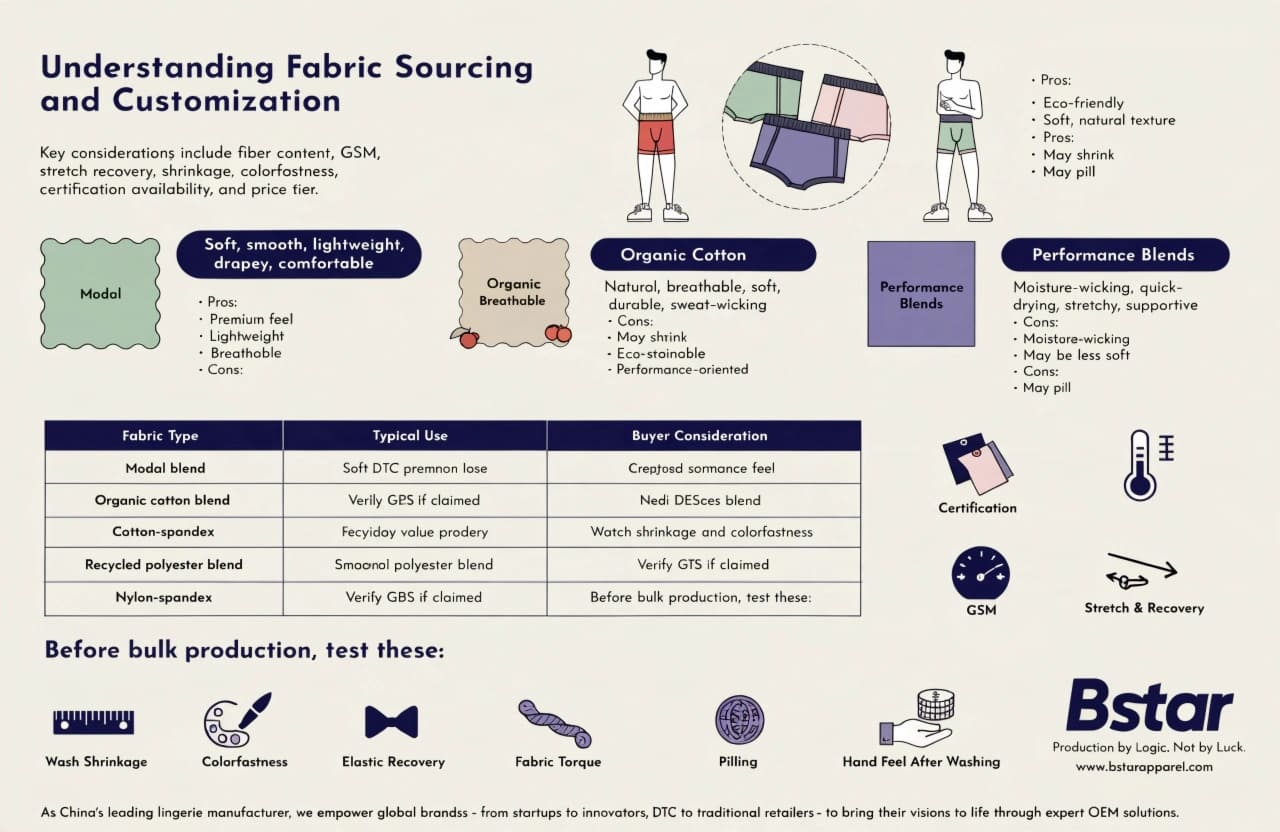
A good boxer underwear manufacturer in China should explain fabric options by fiber content, GSM, stretch recovery, shrinkage, colorfastness1, certification availability, and price tier. Modal, organic cotton, cotton-spandex, recycled blends, and performance fabrics can all work, but each needs testing against your brand promise.
Fabric Is a Product Strategy Decision
I often see early-stage brands start with one question: “What is your best fabric?” I understand the question, but there is no single best fabric. There is only the best fabric for your customer, price point, and sales channel.
For boxer briefs, I usually discuss these factors first:
- Hand feel
- Stretch and recovery
- Shrinkage after washing
- Breathability expectations
- Print or solid dye requirements
- Sustainability claims
- Target retail price
- MOQ for custom colors
Common Fabric Options
| Fabric Type | Typical Use | Buyer Consideration |
|---|---|---|
| Modal blend | Soft DTC premium feel | Check pilling and recovery |
| Organic cotton blend | Natural positioning | Verify GOTS if claimed |
| Cotton-spandex | Everyday value product | Watch shrinkage and colorfastness |
| Recycled polyester blend | Performance or eco angle | Verify GRS if claimed |
| Nylon-spandex | Smooth performance feel | Test heat and elasticity response |
What I Recommend Testing
Before bulk production, I suggest testing:
- Wash shrinkage2
- Colorfastness
- Elastic recovery
- Fabric torque
- Pilling
- Hand feel after washing
At BSTAR, our team supports fabric sourcing, design advice, and cost-control discussion before production. This is useful when a brand wants a premium product but still needs realistic landed cost. A reliable boxer underwear manufacturer in China should not push one fabric blindly. The supplier should help you understand trade-offs.
For example, a very soft fabric may create a strong first impression, but it still needs to hold shape after repeated wear. A lower-cost fabric may look fine on a sample, but it may not support the brand’s return-rate targets. Good sourcing is not just about fabric price. It is about customer experience after ten washes.
The Sampling Process: How Can a Boxer Underwear Manufacturer in China Help Evaluate Fit, 3D Pouch Construction, and Elasticity?
A beautiful sample photo does not prove fit. Boxer underwear is worn close to the body, so small errors in pouch shape, leg opening, rise, or waistband tension become customer complaints fast. Sampling must test comfort, not just appearance.
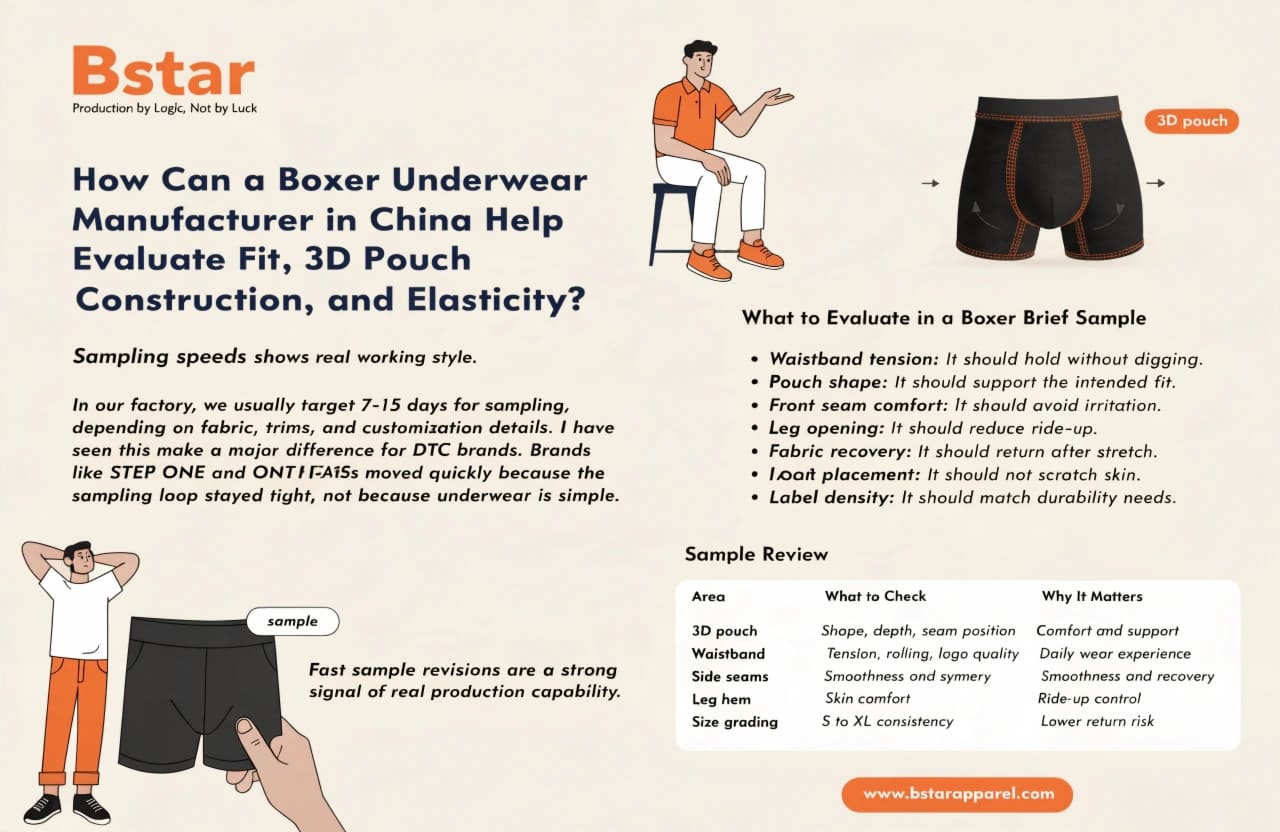
A strong boxer underwear manufacturer in China should provide a structured sampling process that checks pattern accuracy, 3D pouch construction, seam comfort, elastic tension, waistband stability, leg ride-up risk, fabric recovery, and size grading before bulk production. Fast sample revisions are a strong signal of real production capability.
Sampling Speed Shows Real Working Style
In our factory, we usually target 7–15 days for sampling, depending on fabric, trims, and customization details. I have seen this make a major difference for DTC brands. Brands like STEP ONE and ONTHATASS moved quickly because the sampling loop stayed tight3, not because underwear is simple.
Sampling is where you learn how a supplier behaves under pressure.
What to Evaluate in a Boxer Brief Sample
You should check:
- Waistband tension: It should hold without digging.
- Pouch shape: It should support the intended fit.
- Front seam comfort: It should avoid irritation.
- Leg opening: It should reduce ride-up.
- Back rise: It should stay stable when sitting.
- Fabric recovery: It should return after stretch.
- Label placement: It should not scratch skin.
- Stitch density: It should match durability needs.
Sample Review Table
| Area | What to Check | Why It Matters |
|---|---|---|
| 3D pouch | Shape, depth, seam position | Comfort and support |
| Waistband | Tension, rolling, logo quality | Daily wear experience |
| Side seams | Smoothness and symmetry | Skin comfort |
| Leg hem | Tightness and recovery | Ride-up control |
| Size grading | S to XL consistency | Lower return risk |
My Practical Tip
I suggest that brands create a small internal wear-test group before approving bulk. Even five to ten testers can reveal issues that a flat measurement chart misses.
You should also give clear feedback. Instead of saying “make it more comfortable,” say:
- “Reduce waistband tension by 5%.”
- “Increase pouch depth by 0.5 cm.”
- “Shorten inseam by 1 cm.”
- “Use softer thread on inner seam.”
A capable boxer underwear manufacturer in China can act faster when feedback is specific.
MOQ and Tiered Pricing: How Can a Boxer Underwear Manufacturer in China Help Balance Inventory and Cost?
MOQ worries many first-time buyers. They fear that a factory will force them into large inventory before they know demand. That fear is reasonable. Over-ordering can hurt cash flow and make product testing slower.
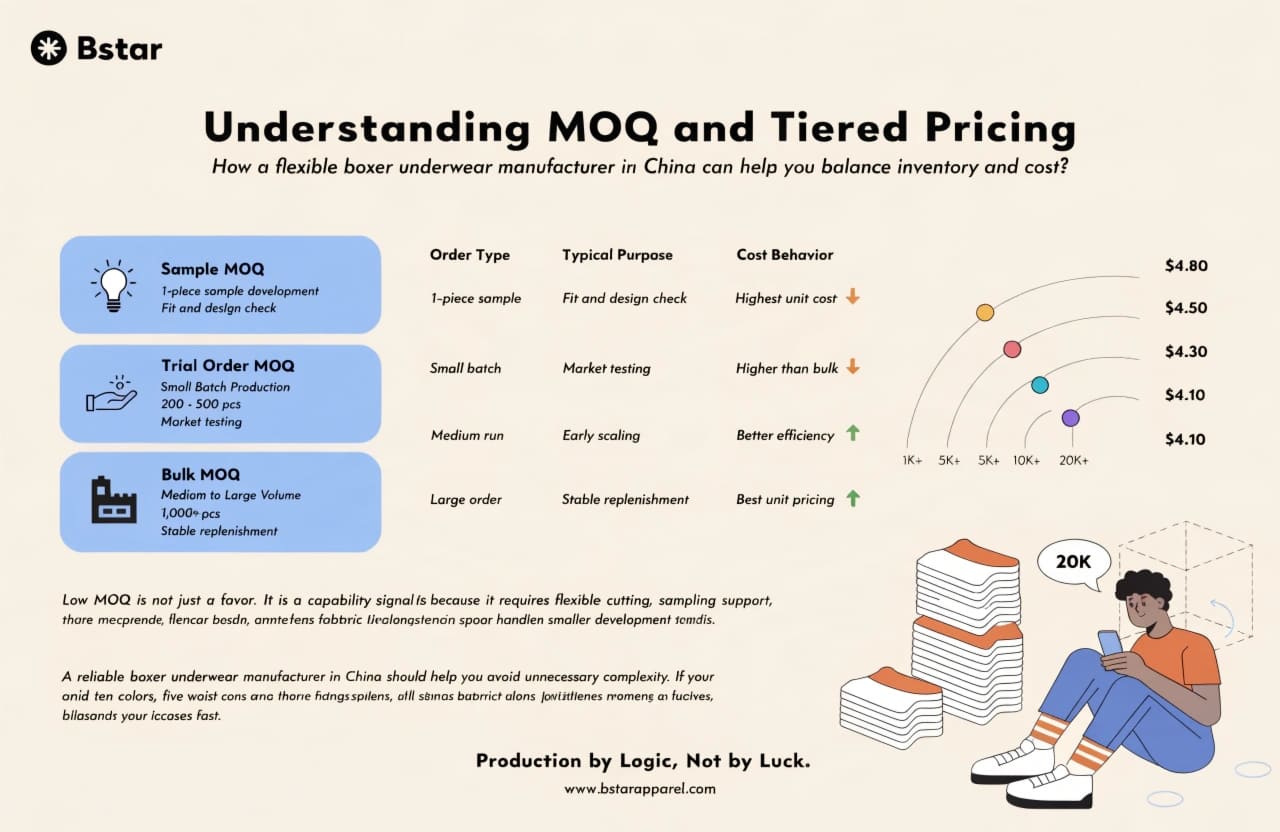
A flexible boxer underwear manufacturer in China should explain sample MOQ, trial-order MOQ, bulk MOQ, and tiered pricing clearly. Low MOQ is not just a favor. It is a capability signal because it requires flexible cutting, sampling support, and production planning systems that can handle smaller development runs.
Low MOQ Is a Capability Signal
One common misunderstanding I hear is: “China factories only want huge orders.” That is not always the right way to frame it. The better question is: What production structure does this supplier have?
At BSTAR, we support 1-piece sample development and small-batch production discussions. This does not mean every custom bulk order can be produced at the same price as a large run. It means we have built workflows for development-stage brands.
How MOQ Affects Price
| Order Type | Typical Purpose | Cost Behavior |
|---|---|---|
| 1-piece sample | Fit and design check | Highest unit cost |
| Small batch | Market testing | Higher than bulk |
| Medium run | Early scaling | Better efficiency |
| Large order | Stable replenishment | Best unit pricing |
The Real Cost Formula
I suggest buyers compare suppliers using this formula:
Landed cost + compliance risk + quality risk + reorder reliability = real sourcing cost
A low FOB quote can become expensive if it excludes:
- Certified fabric
- Proper trims
- Color testing
- Pre-shipment inspection
- Packaging requirements
- Rework cost
- Delayed delivery cost
How to Plan Smartly
For a first order, I usually recommend testing fewer SKUs and more focused colors. For example:
- Start with 2–3 core colors.
- Use one proven fabric base.
- Limit waistband variations.
- Test size curve based on expected sales.
- Reorder once customer feedback is clear.
A reliable boxer underwear manufacturer in China should help you avoid unnecessary complexity. If your first order has ten colors, five waistband types, and three fabric blends, your risk increases fast.
Quality Control Standards: How Should a Boxer Underwear Manufacturer in China Implement AQL 2.5/4.0 Inspection Before Shipment?
Quality problems become expensive after goods leave the factory. A small sewing defect may look minor, but if customers find it after delivery, your brand pays through refunds, reviews, and lost trust.
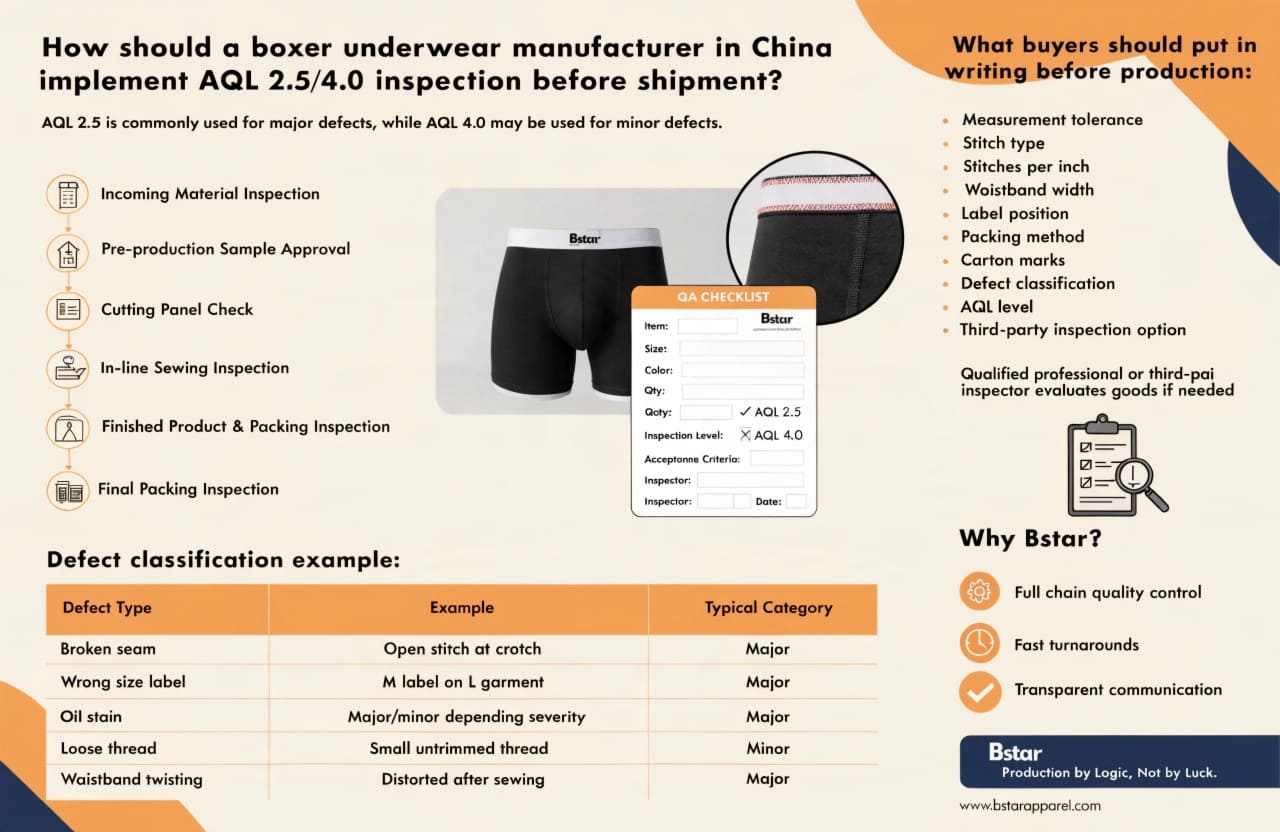
A professional boxer underwear manufacturer in China should use clear QC checkpoints and AQL inspection before shipment. AQL 2.5 is commonly used for major defects, while AQL 4.0 may be used for minor defects4. Buyers should confirm defect definitions, sample size, inspection level, and acceptance criteria in writing.
QC Must Start Before Final Inspection
At BSTAR, we use a full-chain quality management approach with six QC checkpoints from incoming material inspection to final packing inspection. I mention this not as a slogan, but because final inspection alone cannot fix a weak process.
For boxer underwear, early QC matters because fabric stretch, seam tension, and waistband behavior must be controlled during production.
Common QC Checkpoints
- Raw material inspection
- Fabric shrinkage and color review
- Pre-production sample approval
- Cutting panel check
- In-line sewing inspection
- Finished product and packing inspection
AQL Defect Examples
| Defect Type | Example | Typical Category |
|---|---|---|
| Broken seam | Open stitch at crotch | Major |
| Wrong size label | M label on L garment | Major |
| Oil stain | Visible stain on front | Major/minor depending severity |
| Loose thread | Small untrimmed thread | Minor |
| Waistband twisting | Distorted after sewing | Major |
What Buyers Should Put in Writing
Before production, I recommend confirming:
- Measurement tolerance
- Stitch type
- Stitches per inch
- Waistband width
- Label position
- Packing method
- Carton marks
- Defect classification
- AQL level
- Third-party inspection option
A qualified professional or third-party inspector can also evaluate goods before shipment if your order size or retail channel requires extra assurance.
A strong boxer underwear manufacturer in China should not resist inspection. Inspection protects both sides. It gives the buyer confidence, and it gives the factory a clear standard to meet.
Clear Tech Packs and English Communication: How Can a Boxer Underwear Manufacturer in China Bridge Culture and Time Zones?
Poor communication creates production mistakes. A missing measurement, unclear fabric code, or delayed approval can shift the whole calendar. When teams work across Europe, the US, and China, small gaps become costly.
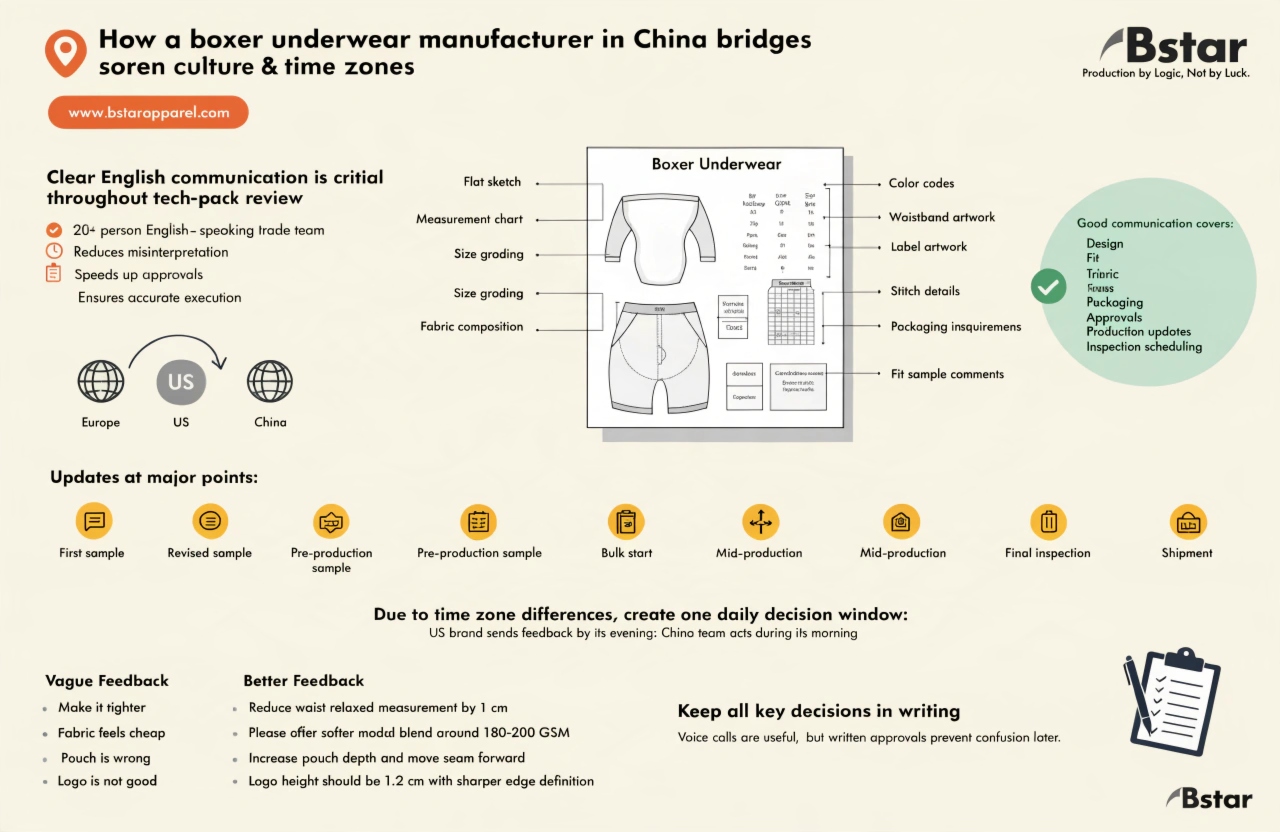
A reliable boxer underwear manufacturer in China should support clear English communication, complete tech-pack review, fast response times, and written confirmation at each stage. Good communication should cover design, fit, fabric, trims, packaging, approvals, production updates, and inspection scheduling.
Communication Is Part of Production
At BSTAR, we have a 20+ person English-speaking trade team. I see this as a production advantage, not just a sales feature. A buyer can have the best design in the world, but if the instructions are unclear, the factory floor cannot execute it correctly.
A tech pack should reduce interpretation.
What Your Tech Pack Should Include
- Flat sketch
- Measurement chart
- Size grading
- Fabric composition
- Fabric GSM
- Color codes
- Waistband artwork
- Label artwork
- Stitch details
- Packaging instructions
- Compliance requirements
- Fit sample comments
Better Feedback Examples
| Vague Feedback | Better Feedback |
|---|---|
| “Make it tighter” | “Reduce waist relaxed measurement by 1 cm” |
| “Fabric feels cheap” | “Please offer softer modal blend around 180–200 GSM” |
| “Pouch is wrong” | “Increase pouch depth and move seam forward” |
| “Logo is not good” | “Logo height should be 1.2 cm with sharper edge definition” |
My Time-Zone Advice
I recommend creating one daily decision window. For example, a US brand can send feedback by its evening, and the China team can act during its morning. This keeps sampling and production moving.
You should also keep all key decisions in writing. Voice calls are useful, but written approvals prevent confusion later.
A capable boxer underwear manufacturer in China should provide updates at major points: first sample, revised sample, pre-production sample, bulk start, mid-production, final inspection, and shipment.
Lead Times, Shipping, and Customs Clearance: How Should a Boxer Underwear Manufacturer in China Help Plan Your Supply Chain Calendar?
Late delivery can ruin a launch even when the product is good. If you do not plan sampling, production, inspection, shipping, and customs together, you may discover too late that your launch date is unrealistic.
A dependable boxer underwear manufacturer in China should help you build a calendar covering sample time, fabric booking, bulk production, QC inspection, export documents, shipping method, customs clearance, and buffer time. Buyers should plan backward from launch date and confirm responsibilities with freight forwarders or customs professionals.
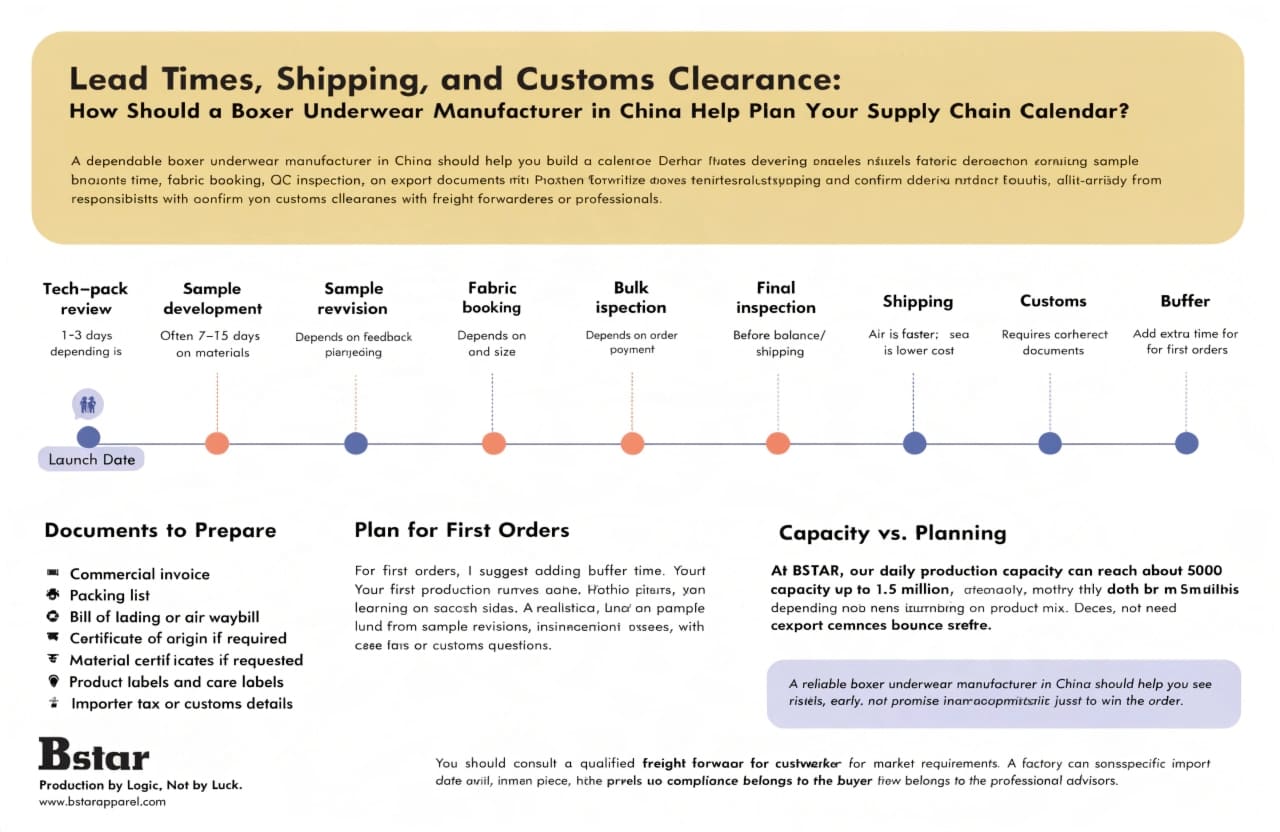
Work Backward From Your Launch Date
I always ask buyers about the target launch date early. Without that date, sampling and production decisions become disconnected. A factory may produce on time, but shipping or customs delays can still create problems.
At BSTAR, our daily production capacity can reach about 50,000 pieces, with monthly capacity up to 1.5 million pieces5, depending on product mix and scheduling. Still, capacity does not remove the need for planning.
Typical Timeline Elements
| Stage | Planning Point |
|---|---|
| Tech-pack review | 1–3 days depending clarity |
| Sample development | Often 7–15 days depending materials |
| Sample revision | Depends on feedback speed |
| Fabric booking | Varies by fabric and color |
| Bulk production | Depends on order size |
| Final inspection | Before balance payment/shipping |
| Shipping | Air is faster; sea is lower cost |
| Customs | Requires correct documents |
Documents to Prepare
You may need:
- Commercial invoice
- Packing list
- Bill of lading or air waybill
- Certificate of origin if required
- Material certificates if requested
- Product labels and care labels
- Importer tax or customs details
You should consult a qualified freight forwarder or customs broker for market-specific import requirements. A factory can support export documents, but import compliance belongs to the buyer and professional advisors.
Build a Buffer
For first orders, I suggest adding buffer time. Your first production run includes learning on both sides. A realistic buffer can protect your launch from sample revisions, fabric delays, inspection issues, or customs questions.
A reliable boxer underwear manufacturer in China should help you see these risks early, not promise an unrealistic date just to win the order.
Frequently Asked Questions
What is the best way to verify a boxer underwear manufacturer in China?
I recommend checking business credentials, factory videos, production areas, certification documents, sample quality, communication speed, and QC process. If possible, request a factory audit or third-party inspection. You should also confirm whether the supplier controls production directly or outsources key steps.
What MOQ should I expect for custom boxer underwear?
MOQ depends on fabric, color, waistband, packaging, and order complexity. Some factories support low-MOQ sampling and small-batch development, while bulk pricing improves at higher quantities. I suggest asking for tiered pricing so you can compare trial orders, medium runs, and replenishment orders.
Which certifications matter most for EU and US underwear brands?
OEKO-TEX® is important for textile safety confidence, while BSCI supports social compliance review. GOTS matters for organic claims, and GRS matters for recycled material claims. You should verify certificate scope, expiry date, issuer, and whether the certificate applies to your exact material.
How long does boxer underwear sampling usually take?
In our workflow, sampling often takes 7–15 days when fabric and design details are clear. Complex customization, special fabric sourcing, or multiple revisions can extend the timeline. Sampling speed is a useful signal of how well the factory handles development pressure.
Should I choose the cheapest boxer underwear quote?
I would not compare factories by FOB price alone. A very low quote may exclude certified fabric, proper inspection, stable elastic, or realistic production planning. You should compare landed cost, compliance risk, quality control, communication, and reorder reliability.
Conclusion
Choosing a boxer underwear manufacturer in China is really a risk-filtering decision. You need to verify the factory, certificates, fabrics, sampling process, MOQ logic, AQL standards, communication quality, and shipping plan before you commit. If you are building a European or US underwear brand and want a direct OEM/ODM partner with sampling support, English communication, and full-process QC, I invite you to contact BSTAR and start with a clear tech-pack review.
-
"Ultimate Guide to Color Fastness of Fabrics", https://www.eysan.com.tw/ultimate-guide-to-color-fastness-of-fabrics/. Colorfastness in textiles is evaluated using the ISO 105 series of test methods, which assess resistance to color change and staining under conditions including washing (ISO 105-C), rubbing (ISO 105-X12), and perspiration (ISO 105-E04); for underwear worn in direct skin contact, colorfastness to perspiration and rubbing is particularly relevant due to potential dye transfer and skin irritation concerns. Evidence role: mechanism; source type: institution. Supports: That colorfastness testing using standardized methods is required for underwear textiles to assess dye stability under washing, perspiration, and rubbing conditions. Scope note: Required colorfastness grades vary by market regulation, retailer specification, and product category; the ISO 105 series defines test methods but not mandatory minimum grades. ↩
-
"Dimensional stability (fabric)", https://en.wikipedia.org/wiki/Dimensional_stability_(fabric). Dimensional change after domestic washing is assessed using standardized methods such as ISO 6330 or AATCC 135, which specify washing conditions, temperature, and measurement procedures; for knit underwear, dimensional stability is particularly critical because shrinkage beyond specified tolerances directly affects fit, size labeling accuracy, and consumer satisfaction. Evidence role: mechanism; source type: institution. Supports: That wash shrinkage in knit fabrics is measured by standardized test methods and is a critical quality parameter for close-fitting garments such as underwear. Scope note: Acceptable shrinkage tolerances vary by buyer specification, fiber type, and market; no single universal standard mandates a specific shrinkage limit for underwear. ↩
-
"Let me show you the good and the ugly behind 86 million …", https://www.instagram.com/reel/DP0qUqOkTbL/. Step One is an Australian direct-to-consumer underwear brand that has publicly reported rapid growth since its founding; ONTHATASS is a European underwear brand operating in the DTC segment, though neither brand has publicly attributed its development speed specifically to sampling loop efficiency in available sources. Evidence role: case_reference; source type: other. Supports: That STEP ONE and ONTHATASS are established direct-to-consumer underwear brands whose market presence can be independently verified. Scope note: The article’s specific claim that these brands succeeded because of tight sampling loops is an editorial assertion not supported by public statements from either brand. ↩
-
"Acceptable Quality Limit, AQL", https://www.qima.com/aql-acceptable-quality-limit. ISO 2859-1 (Sampling procedures for inspection by attributes) defines Acceptance Quality Limits as the quality level that is the worst tolerable process average; in apparel industry practice, AQL 2.5 is widely applied to major defects and AQL 4.0 to minor defects, though specific levels are contractually determined between buyer and supplier. Evidence role: definition; source type: institution. Supports: That AQL levels such as 2.5 and 4.0 are defined within the ISO 2859 sampling inspection standard and are commonly applied in garment quality control to distinguish acceptance thresholds for major and minor defects. Scope note: AQL levels are not universally mandated for apparel; the appropriate level depends on product category, buyer requirements, and contractual agreement. ↩
-
"Textile industry in China", https://en.wikipedia.org/wiki/Textile_industry_in_China. China’s National Bureau of Statistics and industry reports from the China National Textile and Apparel Council document the country’s position as the world’s largest apparel manufacturer by volume, providing macroeconomic context within which individual factory capacity figures for underwear production can be assessed. Evidence role: general_support; source type: government. Supports: That China’s textile and apparel manufacturing sector operates at significant scale, providing context for evaluating individual factory capacity claims in the underwear segment. Scope note: Aggregate national statistics do not validate individual factory capacity claims; buyers should verify specific capacity figures through factory audits, production records, or third-party assessments. ↩
I found the tips on checking factory certifications particularly insightful; it really makes a difference when selecting a reliable partner. Using a checklist for verification has been a game changer in my sourcing process. I’ve also been utilizing a free online resource for industry standards that helps keep everything organized.
The section on assessing potential manufacturers’ certifications really stood out to me. It’s crucial to ensure they comply with international standards before making a decision. I often consult industry forums for firsthand experiences with different suppliers.
I appreciate how the article emphasizes the importance of checking for certifications when selecting a boxer underwear manufacturer in China. It’s so crucial to verify quality standards before making any decisions. A useful resource I often refer to for supplier evaluations is a guide on industry best practices.