How to Find a Reliable Boxer Underwear Manufacturer in China: A Complete Guide for European & US Brands?
Finding a reliable boxer underwear manufacturer in China can feel risky when your brand reputation depends on fit, comfort, compliance, and repeatable delivery. A low quote may look attractive, but one missed certification or weak waistband can become expensive fast. I will show you how I evaluate real factory signals before a first order.
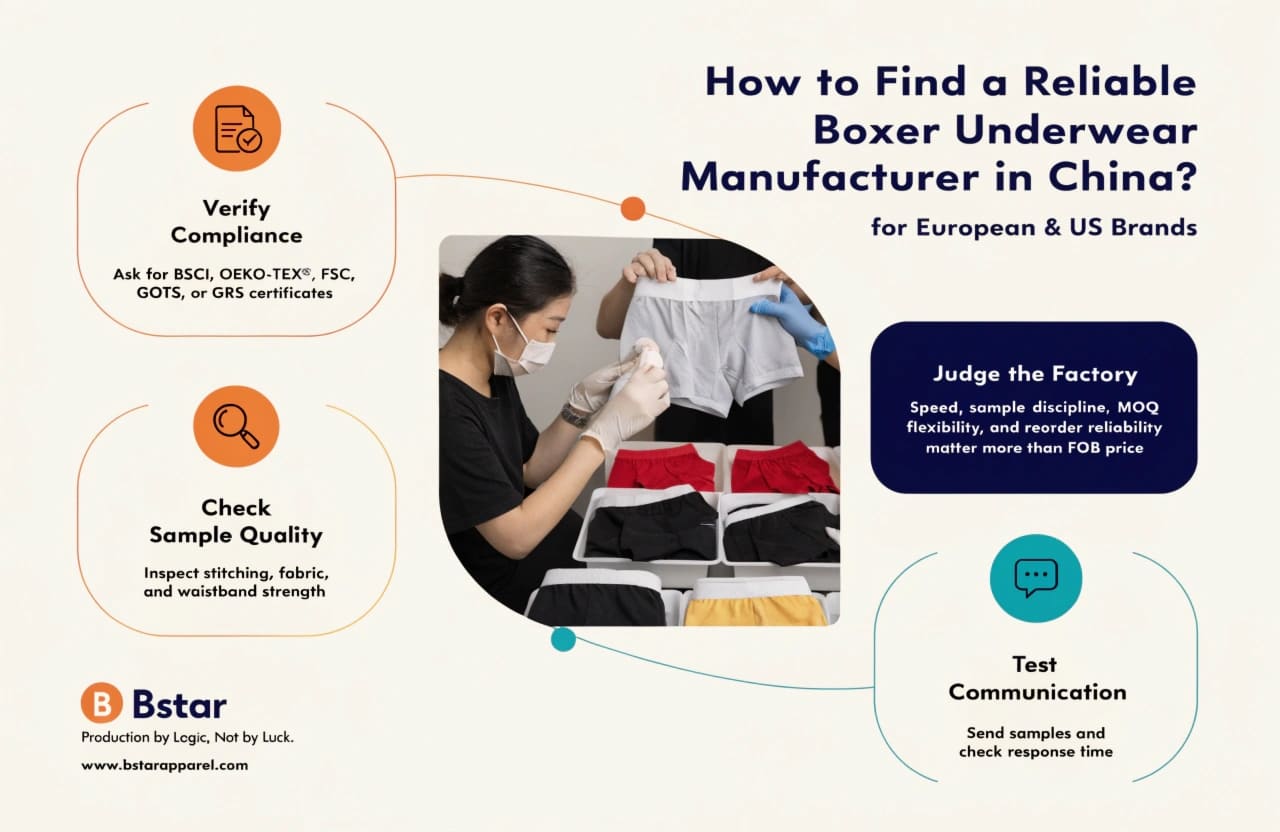
A reliable boxer underwear manufacturer in China should prove three things early: verified compliance, consistent underwear workmanship, and flexible production support. Ask for BSCI, OEKO-TEX®, FSC, GOTS, or GRS documents upfront, check sample quality closely, and judge the factory by communication speed, sampling discipline, MOQ flexibility, and reorder reliability—not only FOB price.
The best sourcing decisions usually happen before production starts. In our daily work with European and US DTC brands, I often see the same pattern: the brands that ask better questions early avoid painful fixes later. Let’s walk through the checks I would use.
What Challenges Should You Understand Before Choosing a Reliable Boxer Underwear Manufacturer in China?
Sourcing boxer underwear looks simple from the outside. You send a tech pack, compare quotes, approve a sample, and place an order. But the real risk sits in the details. If you miss those details, your first shipment can create returns, delays, or compliance problems.
A reliable boxer underwear manufacturer in China helps you reduce sourcing risk before you commit money. The biggest challenges are hidden costs, unclear certifications, unstable sizing, weak stitching, slow sampling, and poor communication. I recommend judging every supplier by landed cost, compliance readiness, workmanship, and the factory’s ability to support repeat orders.
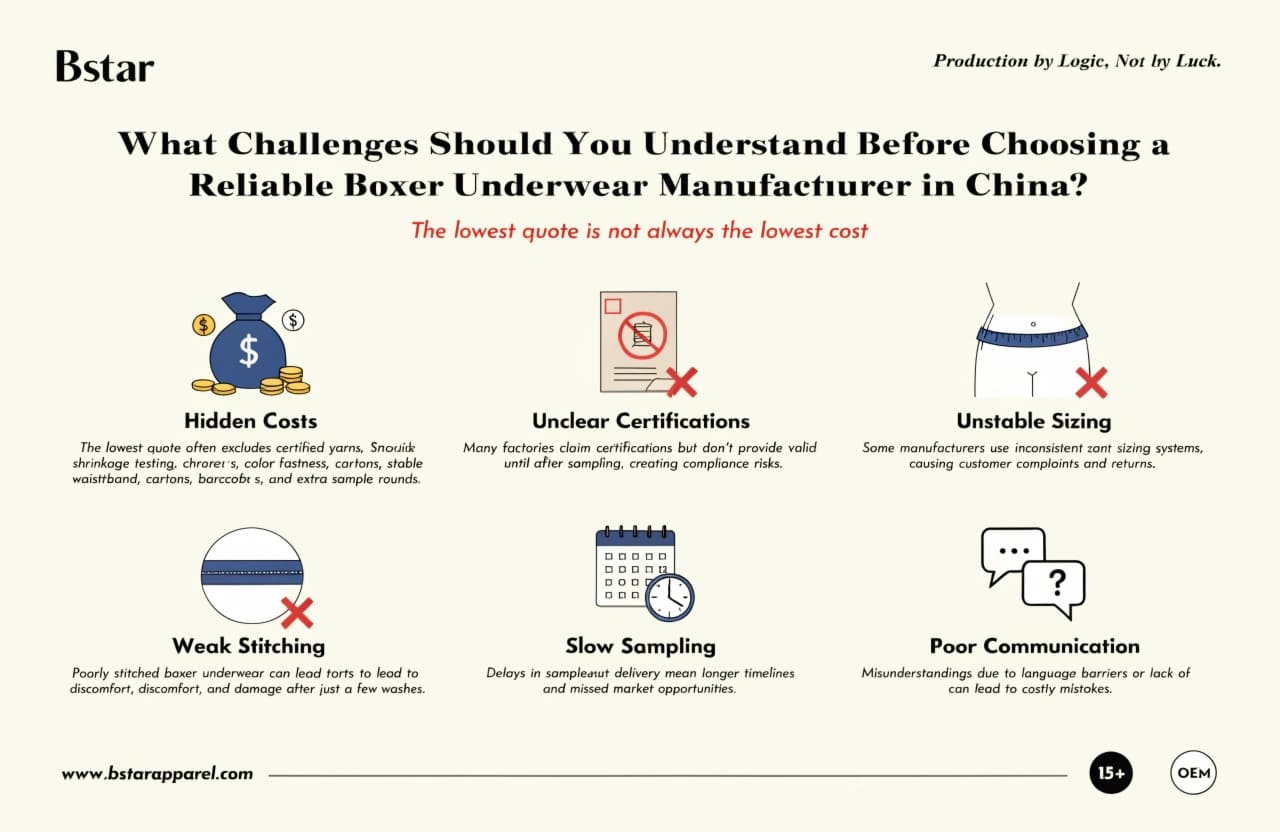
The lowest quote is not always the lowest cost
In our experience with European DTC brands, the most dangerous mistake is treating the cheapest FOB price as the final answer. Boxer briefs and boxer underwear may look like basic knitwear, but the product still carries many cost drivers.
A low price may exclude:
- Certified yarns or trims
- Proper shrinkage testing
- Color fastness checks
- Stable waistband quality
- Carton and barcode requirements
- Rework after failed inspection
- Extra sample rounds
- Compliance documentation support
I have seen buyers compare two quotes and choose the cheaper one without asking what was included. Later, they discovered that the lower price used a substitute fabric, a weaker waistband, or no certified material documentation. The result was not savings. The result was delay.
The better comparison is:
| Comparison Point | Weak Buying Question | Better Buying Question |
|---|---|---|
| Price | “What is your FOB price?” | “What is included in this price?” |
| Compliance | “Are you certified?” | “Can you send valid certificates before sampling?” |
| Quality | “Can you make this style?” | “How do you control waistband, stitching, shrinkage, and packing?” |
| Delivery | “How fast can you ship?” | “What is your realistic sample and bulk timeline?” |
| Reorders | “Can you do my first order?” | “Can you maintain the same quality for repeat orders?” |
Boxer underwear has small details that customers feel immediately
A T-shirt can sometimes hide small workmanship issues. Boxer underwear cannot. The customer wears it close to the skin1. If the waistband rolls, the seam rubs, the pouch fit is wrong, or the leg opening stretches out, the customer notices on the first wear.
When I review boxer samples, I usually focus on four customer-facing points:
- Waistband recovery after stretching
- Flatlock seam smoothness against the skin
- Pattern balance between front pouch, back rise, and leg opening
- Fabric hand feel after washing
These points matter because DTC brands live on repeat purchase. One uncomfortable batch can hurt reviews, refunds, and subscription retention2.
Communication is also a quality signal
I do not treat fast replies as a nice bonus. I treat them as a production signal. If a factory cannot answer clearly during inquiry and sampling, it may struggle more during bulk production.
At BSTAR, we built a 20+ person English-speaking trade team because European and US brands need fast answers. When brands like ONTHATASS, STEP ONE, and PIMP SHRIMP move through development, the speed of clarification matters as much as the machine capacity. A tight sampling loop helps both sides catch problems while they are still cheap to fix.
My simple rule is this: if communication is confusing before payment, it rarely becomes clearer after payment.
What Credentials Should a Reliable Boxer Underwear Manufacturer in China Show First?
Certificates can feel like paperwork until a retailer, platform, or customs process asks for them. Then they become urgent. If you wait until after sampling to ask for compliance documents, you may need to restart sourcing or change materials late in the process.
A reliable boxer underwear manufacturer in China should show relevant compliance documents early, especially BSCI for social responsibility and OEKO-TEX® for safer textiles. Depending on your brand positioning, FSC, GOTS, and GRS may also matter. These credentials support market access, retailer trust, and lower downstream compliance risk.
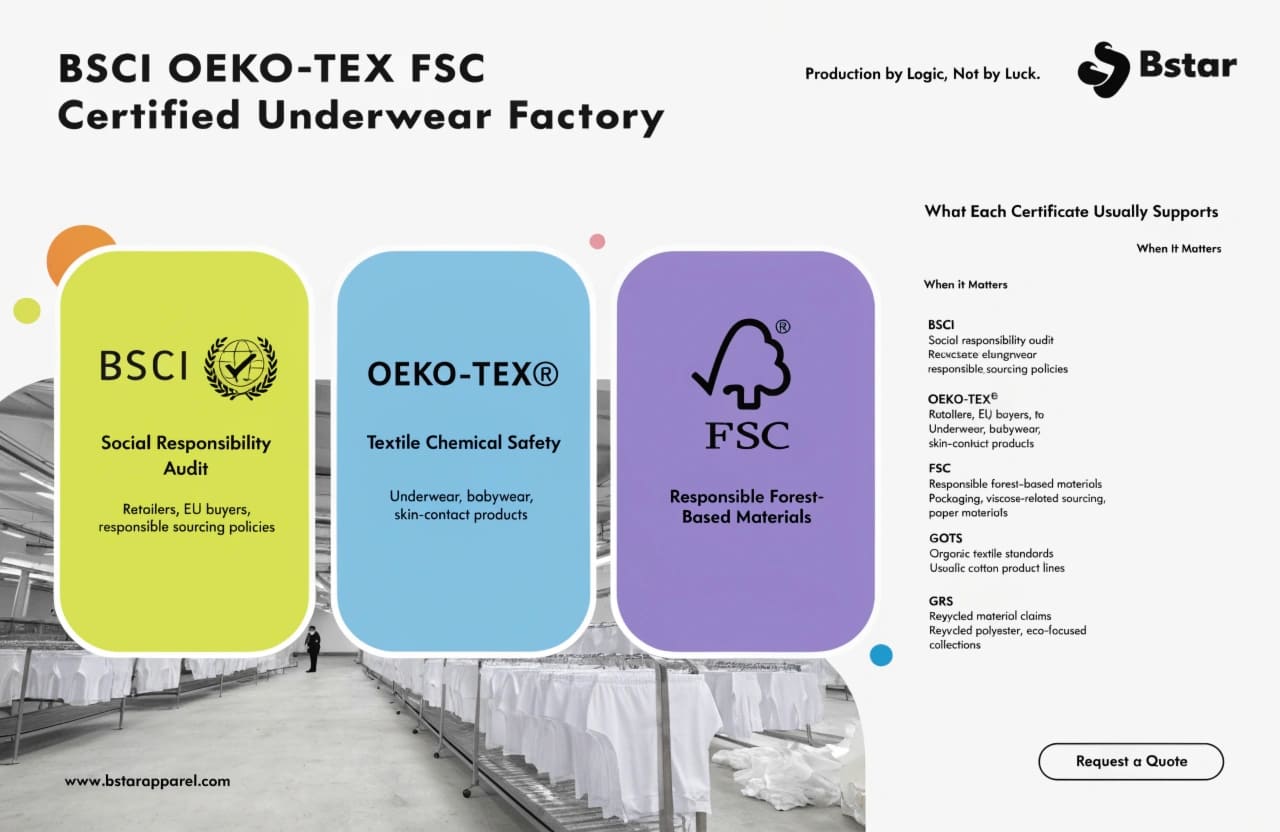
Why BSCI matters for European and US brands
BSCI is not a fabric certificate. It relates to social responsibility and factory working conditions3. For European buyers, this can be especially important because retailers and brand partners often expect responsible sourcing evidence.
At BSTAR, we hold BSCI certification because our customers need more than production capacity. They need a supply chain that can stand up to review. This is not just a badge on a website. It supports the buyer when they need to answer internal or retail compliance questions.
Why OEKO-TEX® matters for underwear
Underwear touches skin for long periods. That makes material safety more sensitive4. OEKO-TEX® certified materials help brands show that textiles meet recognized chemical safety standards5.
When I speak with first-time DTC founders, I often hear this question:
“Can we start with normal fabric first and upgrade certification later?”
Sometimes that sounds practical. But it can create rework. If your brand promise includes comfort, skin safety, sustainability, or retail readiness, you should build certification into the product from the beginning.
FSC, GOTS, and GRS support specific brand claims
Not every boxer underwear style needs every certification. But if your brand uses sustainability claims, you need to match the claim with documentation.
| Certification | What It Usually Supports | When It Matters |
|---|---|---|
| BSCI | Social responsibility audit | Retailers, EU buyers, responsible sourcing policies |
| OEKO-TEX® | Textile chemical safety | Underwear, babywear, skin-contact products |
| [FSC | Responsible forest-based materials | Packaging, viscose-related sourcing, paper materials](https://forestecocertification.com/what-is-fsc-certified-viscose/)[^6] |
| [GOTS | Organic textile standards | Organic cotton product lines](https://global-standard.org/images/resource-library/documents/standard-and-manual/GOTS_7.0__SIGNED_.pdf)[^7] |
| [GRS | Recycled material claims | Recycled polyester, eco-focused collections](https://www.scsglobalservices.com/services/global-recycled-standard)[^8] |
At BSTAR, our raw materials can be supported by FSC, OEKO-TEX®, GOTS, and GRS certifications. I mention this at the point where buyers need it most: before they invest time in sampling. If the certificate path does not fit the product plan, it is better to know early.
What you should ask in your first inquiry
I suggest you ask for certificates before you send a full development package. This saves time for both sides.
Your first inquiry can include:
- “Can you share your latest BSCI audit document?”
- “Can you provide OEKO-TEX® certified fabric options for men’s boxer briefs?”
- “Do you support GOTS organic cotton or GRS recycled yarns?”
- “Can the certificate scope match the material we plan to use?”
- “Can you support documentation for EU or US DTC sales?”
A professional factory should not feel surprised by these questions. In our own workflow, we expect serious brands to ask them early.
How Should You Evaluate Workmanship from a Reliable Boxer Underwear Manufacturer in China?
A sample can look good in photos and still fail on the body. Boxer underwear workmanship must be checked by hand, by stretch, and after washing. If your evaluation only focuses on color and general appearance, you may miss the problems that customers complain about.
A reliable boxer underwear manufacturer in China should produce samples with stable waistband recovery, smooth flatlock stitching, balanced seams, accurate sizing, and clean finishing. You should test stretch, wash shrinkage, seam comfort, label placement, and measurement tolerance before approving bulk production.
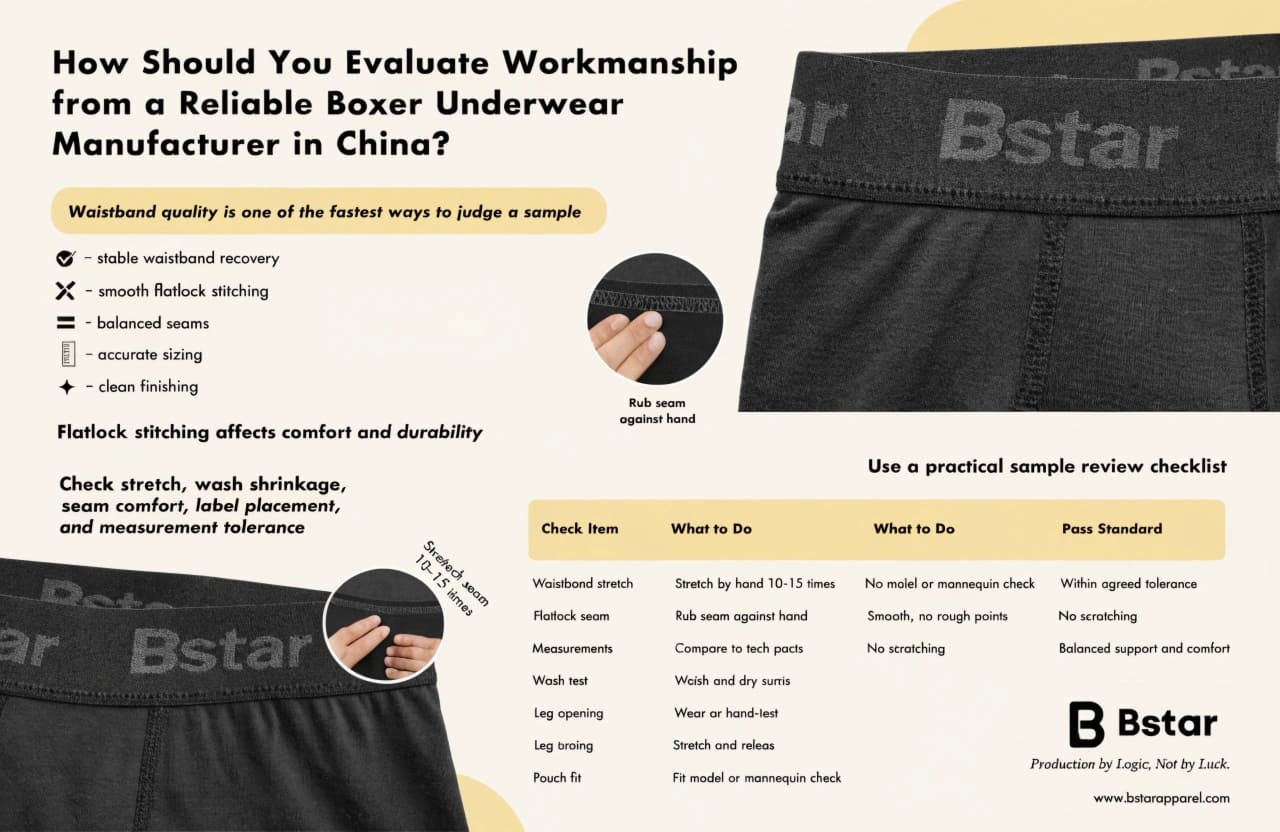
Waistband quality is one of the fastest ways to judge a sample
The waistband is not just decoration. It controls comfort, fit, and perceived quality. A premium waistband should feel firm but not harsh. It should recover after stretching and sit flat after washing.
When I inspect waistband quality, I look at:
- Elastic recovery: Does the waistband bounce back after stretch?
- Edge stability: Does it curl or fold?
- Logo clarity: Is the jacquard or printed logo clean?
- Attachment seam: Is the waistband evenly joined to the body?
- Skin feel: Does the inner side feel scratchy?
For DTC underwear brands, waistband quality also affects brand memory. A customer may not remember the fabric GSM, but he will remember whether the waistband dug into his waist.
Flatlock stitching affects comfort and durability
Flatlock stitching is common in underwear because it creates a smoother seam6. But the execution still matters. If the seam is too bulky, uneven, or loose, it can rub against the skin or open after wear.
A good flatlock seam should be:
- Smooth to the touch
- Even in stitch density
- Stable under stretch
- Clean at seam intersections
- Consistent across left and right panels
At BSTAR, we use multiple quality checkpoints because small seam issues can become big customer issues. Our AQL-based inspection process includes raw material checks, in-line inspection, semi-finished checks, and final packing inspection7. I prefer this layered approach because underwear quality cannot be inspected only at the end.
Use a practical sample review checklist
I recommend that brands create a simple scorecard. It does not need to be complicated. It only needs to be consistent.
| Check Item | What to Do | Pass Standard |
|---|---|---|
| Waistband stretch | Stretch by hand 10–15 times | Good recovery, no waves |
| Flatlock seam | Rub seam against hand | Smooth, no rough points |
| Measurements | Compare to tech pack | Within agreed tolerance |
| Wash test | Wash and dry sample | No major shrinkage or twisting |
| Label comfort | Wear or hand-test | No scratching |
| Leg opening | Stretch and release | No deformation |
| Pouch fit | Fit model or mannequin check | Balanced support and comfort |
Why workmanship should be reviewed before price negotiation
Some buyers ask for price reductions before the sample is fully reviewed. I understand the pressure. Every brand has a target margin. But if the product needs premium waistband, certified fabric, custom packaging, and tight tolerances, the factory must build those costs into the quote.
A better process is:
- Confirm product positioning
- Confirm compliance needs
- Develop sample
- Evaluate workmanship
- Adjust construction if needed
- Confirm final costing
- Approve pre-production sample
This order helps avoid false savings. It also gives the factory enough information to quote responsibly.
How Do MOQ, Sample Development, and Timelines Work with a Reliable Boxer Underwear Manufacturer in China?
MOQ is one of the first questions DTC founders ask. I understand why. A first order is risky, especially when the brand is testing fit, ads, and customer feedback. But MOQ should not be treated as a fixed wall. It should be treated as a capability question.
A reliable boxer underwear manufacturer in China should explain MOQ by fabric, color, waistband, packaging, and production method. Flexible factories may support 1-piece sampling, small-batch development, and 7–15 day sample turnaround. Clear timelines help brands test faster and avoid overbuying before product-market fit.
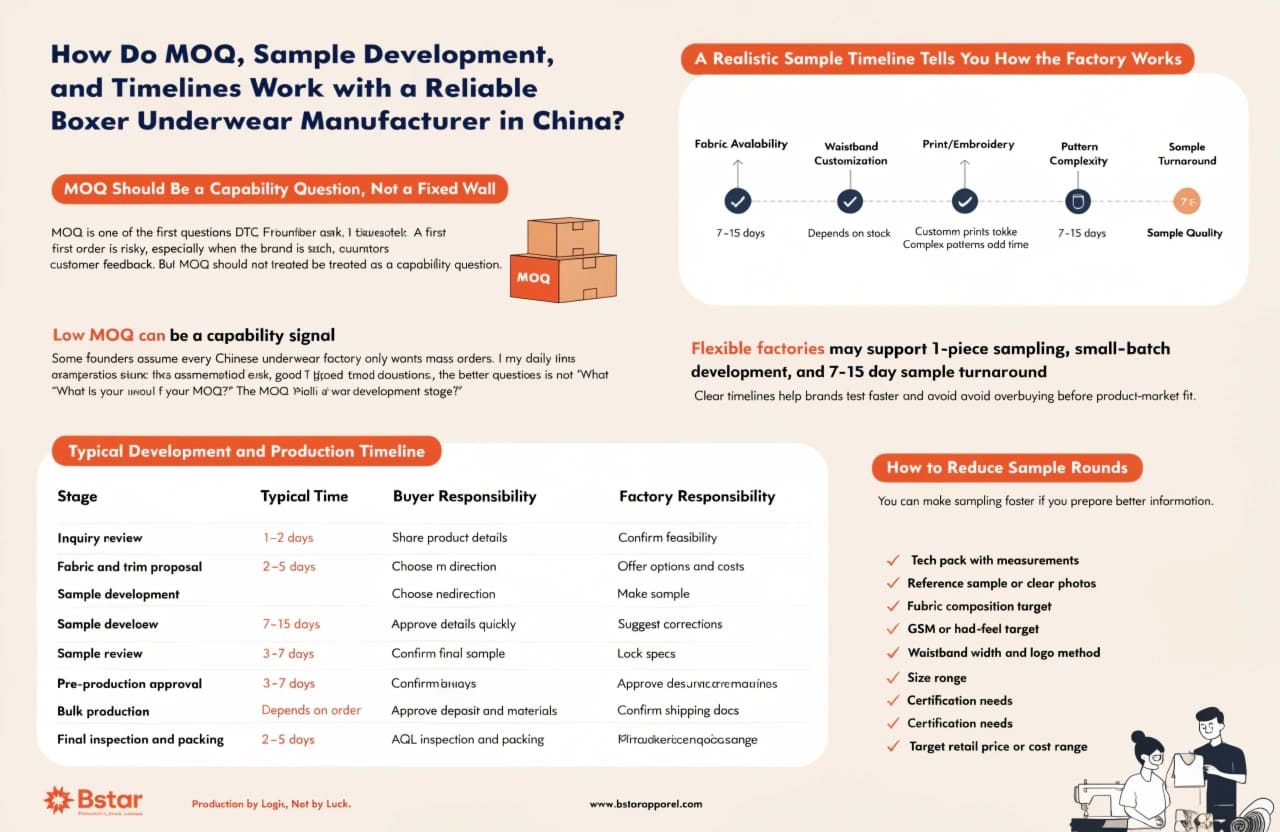
Low MOQ can be a capability signal
Some founders assume every Chinese underwear factory only wants mass orders. In my daily inquiry work, I see this assumption block good conversations. The better question is not “What is your MOQ?” The better question is “What MOQ can you support for my exact development stage?”
A factory that can support small-batch development usually has a different internal setup:
- A dedicated sampling team
- Fast pattern adjustment
- Flexible cutting lines
- Access to available fabric options
- Clear approval workflow
- Salespeople who can translate brand needs into factory instructions
At BSTAR, we support 1-piece sampling and small-batch development because DTC brands often need to test before scaling. This flexibility is useful for first collections, influencer drops, size testing, and subscription model validation.
A realistic sample timeline tells you how the factory works
In our factory, a typical sample timeline is 7–15 days, depending on fabric availability, waistband customization, print or embroidery, and pattern complexity. This timeline is not just a date. It shows how the factory handles internal coordination.
A slow sample process may come from:
- Missing fabric information
- Unclear tech pack
- Custom waistband delays
- Pattern correction rounds
- Late comments from the buyer
- No dedicated English-speaking follow-up
When I see a sample move smoothly, I usually see a better bulk order later. Sampling speed does not guarantee perfection, but it predicts communication behavior under pressure.
Typical development and production timeline
Every project is different, but a practical timeline may look like this:
| Stage | Typical Time | Buyer Responsibility | Factory Responsibility |
|---|---|---|---|
| Inquiry review | 1–2 days | Share product details | Confirm feasibility |
| Fabric and trim proposal | 2–5 days | Choose direction | Offer options and costs |
| Sample development | 7–15 days | Approve details quickly | Make sample |
| Sample review | 3–7 days | Test and comment | Suggest corrections |
| Pre-production approval | 3–7 days | Confirm final sample | Lock specs |
| Bulk production | Depends on order | Approve deposit and materials | Produce and inspect |
| Final inspection and packing | 2–5 days | Confirm shipping docs | AQL inspection and packing |
BSTAR has 8,000 square meters of modern production space and 300+ machines, with daily capacity up to about 50,000 pieces and monthly capacity up to about 1.5 million pieces8. I do not share those numbers to push big orders. I share them because brands need to know whether a partner can grow with them after the test order works.
How to reduce sample rounds
You can make sampling faster if you prepare better information. I suggest sending:
- Tech pack with measurements
- Reference sample or clear photos
- Fabric composition target
- GSM or hand-feel target
- Waistband width and logo method
- Size range
- Packaging requirements
- Certification needs
- Target retail price or cost range
If you do not have a complete tech pack, you can still start. Our R&D team often helps with pattern optimization, cost control, and trend suggestions. However, the more direction you provide, the faster the first sample will match your expectation.
How Can You Streamline Your Supply Chain with a Reliable Boxer Underwear Manufacturer in China?
Changing suppliers or starting your first China order can feel uncomfortable. You may worry about quality drift, late replies, unclear documents, and production surprises. A strong partner should make the process visible, not mysterious. That visibility is what builds trust.
A reliable boxer underwear manufacturer in China streamlines your supply chain by combining development, sourcing, production, inspection, and communication in one controlled workflow. You should look for transparent updates, clear quality checkpoints, English-speaking support, and repeatable systems from first sample to final shipment.
The best transition starts with a risk audit
If you already have a supplier, I would not suggest switching blindly. I would first audit the pain points.
Ask yourself:
- Are late deliveries hurting launches?
- Are measurements drifting between reorders?
- Are customers complaining about seams or waistband?
- Are certificates incomplete or hard to obtain?
- Are emails slow or unclear?
- Are you forced to order more stock than you need?
- Are inspection results inconsistent?
Once you define the risk, the transition becomes easier. You are not just looking for a cheaper quote. You are looking for a partner who solves specific problems.
A vertically integrated workflow reduces handoff errors
BSTAR is a knitwear OEM/ODM manufacturer in Xiaolan, Zhongshan, Guangdong. We have worked in this category for 19 years9. Our value is not only sewing capacity. It is the ability to coordinate design advice, material sourcing, sampling, production, quality control, and export communication under one workflow.
This matters because handoff errors create sourcing risk. If one party controls fabric, another controls sewing, and another controls packing, small misunderstandings can multiply. A more integrated process helps keep responsibility clear.
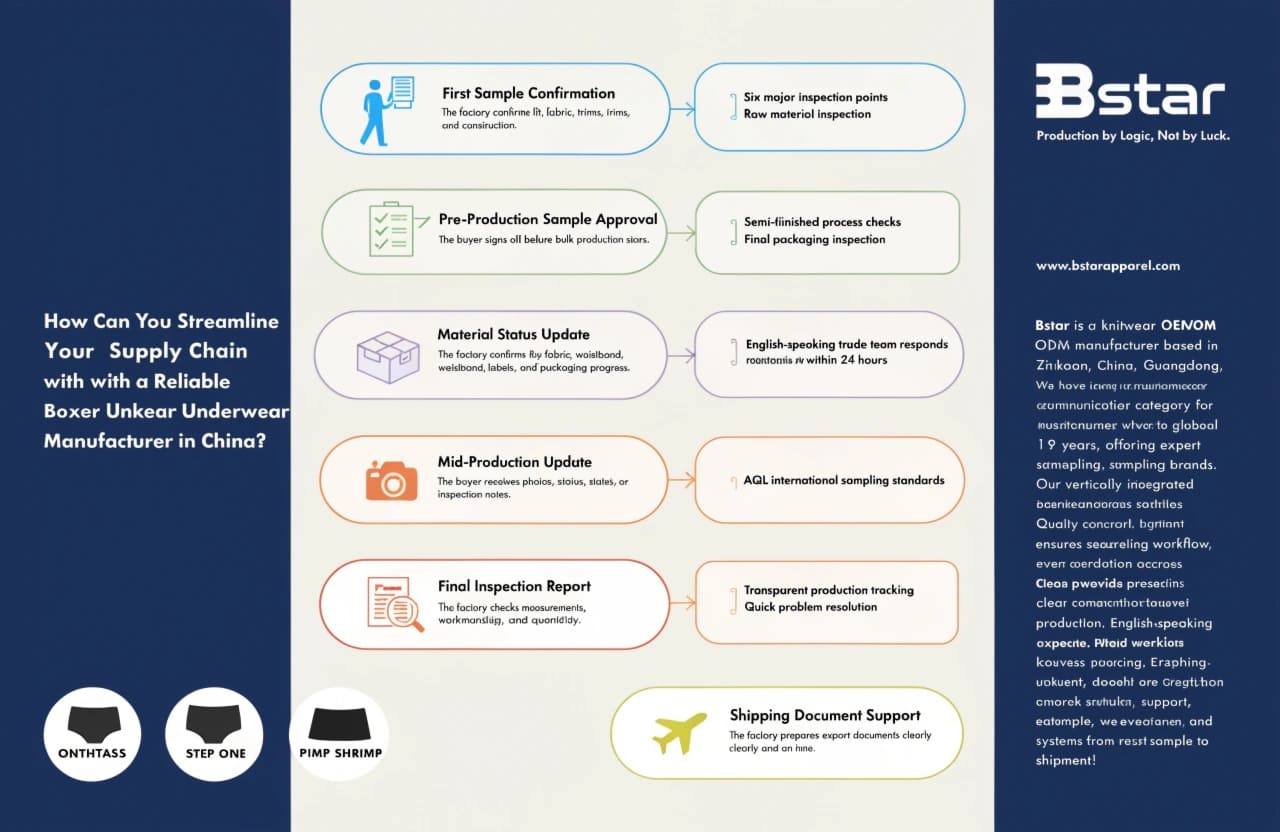
Our quality control system includes six major inspection points, covering raw material inspection, semi-finished process checks, and final packaging inspection. We also follow AQL international sampling standards. For underwear, this structure is important because defects can appear at different stages.
What transparent production management should look like
I believe overseas buyers should not have to guess what is happening. A good process should include:
-
First sample confirmation
The factory confirms fit, fabric, trims, color, and construction. -
Pre-production sample approval
The buyer signs off before bulk production starts. -
Material status update
The factory confirms fabric, waistband, labels, and packaging progress. -
Mid-production update
The buyer receives photos, status, or inspection notes. -
Final inspection report
The factory checks measurements, workmanship, packing, and quantity. -
Shipping document support
The factory prepares export documents clearly and on time.
Our English-speaking trade team responds within 24 hours because time zones already create friction. Slow communication makes that friction worse. Fast, clear communication does not solve every issue, but it helps both sides solve issues before they become urgent.
How to test a new partner without overcommitting
I usually recommend a staged approach for early-stage brands.
| Stage | Goal | Recommended Action |
|---|---|---|
| Stage 1 | Verify communication | Send a detailed inquiry and review response quality |
| Stage 2 | Verify compliance | Request certificates and material options |
| Stage 3 | Verify workmanship | Develop and wash-test samples |
| Stage 4 | Verify production | Place a small first order if possible |
| Stage 5 | Verify repeatability | Reorder and compare quality consistency |
This approach helps you build trust with evidence. It also gives the factory a fair chance to understand your brand.
For brands like ONTHATASS, STEP ONE, and PIMP SHRIMP, speed and clarity were important because underwear is a repeat-purchase category. The product must feel consistent. The supply chain must also feel consistent. That is the real goal of choosing a reliable partner.
Frequently Asked Questions
What is the best way to verify a boxer underwear factory in China?
I would verify the factory through certificates, sample quality, communication speed, and production transparency. Ask for BSCI, OEKO-TEX®, FSC, GOTS, or GRS documents where relevant. Then test samples for waistband recovery, flatlock stitching, shrinkage, sizing, and comfort before placing bulk orders.
What MOQ should I expect for custom boxer underwear?
MOQ depends on fabric, color, waistband, trims, and packaging. Some factories only support larger runs, while flexible OEM/ODM partners may support 1-piece sampling and small-batch development. I suggest asking for MOQ by style, color, size range, and customization level.
How long does boxer underwear sampling usually take?
In our workflow, boxer underwear samples usually take 7–15 days, depending on fabric availability, pattern complexity, waistband customization, and print or label requirements. A clear tech pack, reference sample, and fast feedback can reduce delays and sample revision rounds.
Which certifications matter most for EU and US underwear brands?
BSCI and OEKO-TEX® are often important starting points. BSCI supports responsible sourcing expectations, while OEKO-TEX® supports textile safety for skin-contact products. FSC, GOTS, and GRS may also matter if your brand uses responsible packaging, organic materials, or recycled material claims.
Should I choose the cheapest underwear manufacturer?
I would not choose based only on the cheapest FOB price. A very low quote may exclude compliance, quality checks, stable materials, or reliable reorders. I recommend comparing landed cost, certification risk, sample quality, communication, and long-term production reliability.
Conclusion
Choosing a reliable boxer underwear manufacturer in China is not a price-hunting exercise. It is a risk-filtering decision. You need a partner who can prove compliance early, develop samples quickly, control waistband and flatlock quality, support realistic MOQ needs, and communicate clearly through production. At BSTAR, we help European and US DTC brands move from idea to finished underwear with certified materials, flexible development, and full-process quality control. If you are planning your next boxer underwear line, send us your tech pack or reference sample, and we will help you evaluate the best production path.
-
"Quality Analysis and Testing of Undergarments", https://lupinepublishers.com/fashion-technology-textile-engineering/fulltext/quality-analysis-and-testing-of-undergarments.ID.000154.php. International textile testing standards, including those published by ISO and ASTM, specify distinct performance criteria for underwear and intimate apparel in areas such as seam strength, dimensional stability after washing, and colorfastness to perspiration, reflecting the more demanding wear conditions and direct skin contact associated with this garment category. Evidence role: expert_consensus; source type: institution. Supports: That industry testing standards and consumer research recognize higher comfort and workmanship requirements for skin-contact garments such as underwear compared with outerwear. Scope note: Specific standard applicability depends on the target market and retailer requirements; not all brands or buyers mandate formal compliance with these standards. ↩
-
"The impact of characteristic factors of the direct-to-consumer marketing …", https://pmc.ncbi.nlm.nih.gov/articles/PMC10944917/. Consumer behavior research in apparel e-commerce consistently identifies product quality and fit satisfaction as primary determinants of repeat purchase intention and subscription retention, with negative first-use experiences disproportionately increasing return rates and reducing customer lifetime value. Evidence role: general_support; source type: research. Supports: That product quality and comfort are significant drivers of repeat purchase and customer retention in direct-to-consumer apparel. Scope note: Most published studies examine apparel broadly rather than underwear specifically; the magnitude of the effect may differ by product category, price point, and brand positioning. ↩
-
"Internet of things", https://en.wikipedia.org/wiki/Internet_of_things. The Business Social Compliance Initiative (BSCI), administered by amfori, is a supply chain auditing program that assesses factories against a Code of Conduct covering workers’ rights, fair remuneration, occupational health and safety, and environmental practices, drawing on ILO conventions and the UN Guiding Principles on Business and Human Rights. Evidence role: definition; source type: institution. Supports: What BSCI audits cover, including labor rights, health and safety, and environmental practices in manufacturing facilities. Scope note: BSCI is an audit program rather than a third-party certification body; audit outcomes vary by auditor and facility, and passing an audit does not guarantee ongoing compliance. ↩
-
"Chemicals from textiles to skin: an in vitro permeation study of …", https://pmc.ncbi.nlm.nih.gov/articles/PMC6133113/. Research on dermal exposure to textile chemicals indicates that prolonged and occlusive skin contact, as occurs with underwear, increases the potential for percutaneous absorption of residual substances such as dyes, finishing agents, and biocides compared with garments worn over other clothing layers. Evidence role: mechanism; source type: research. Supports: Why prolonged dermal contact with textiles increases potential chemical exposure compared with non-contact or intermittent-contact garments. Scope note: Actual exposure levels depend on fabric construction, chemical concentration, and individual skin condition; published studies vary in methodology and the specific substances examined. ↩
-
"Oeko-Tex", https://en.wikipedia.org/wiki/Oeko-Tex. OEKO-TEX Standard 100 is an independent testing and certification system for textile materials that screens for over 100 harmful substances, including pesticides, heavy metals, and formaldehyde, with stricter limits applied to products in direct skin contact such as underwear. Evidence role: definition; source type: institution. Supports: What OEKO-TEX Standard 100 certification tests for and which substance limits it enforces in skin-contact textiles. Scope note: Certification scope and substance lists are periodically updated; the specific version year should be confirmed against current OEKO-TEX published criteria. ↩
-
"Overlock", https://en.wikipedia.org/wiki/Overlock. Flatlock stitching, also termed a flat seam or cover stitch, joins fabric panels so that seam allowances lie flat rather than overlapping, reducing seam bulk and the ridge that can cause skin abrasion in close-fitting garments such as underwear and activewear. Evidence role: definition; source type: encyclopedia. Supports: How flatlock stitching differs mechanically from other seam constructions and why it reduces bulk and skin irritation in close-fitting garments. Scope note: Comfort outcomes depend on stitch density, thread type, and fabric weight in addition to seam construction; flatlock alone does not guarantee a comfortable result. ↩
-
"Acceptable quality limit", https://en.wikipedia.org/wiki/Acceptable_quality_limit. Acceptable Quality Limit (AQL) sampling, standardized under ISO 2859-1, defines the maximum defect rate considered acceptable in a production lot; inspectors use statistical sampling tables to determine how many units to examine and how many defects trigger lot rejection, with common garment inspection levels set at AQL 2.5 for major defects and AQL 4.0 for minor defects. Evidence role: definition; source type: encyclopedia. Supports: What AQL sampling means statistically and how it is applied in garment quality inspection. Scope note: AQL sampling is a probabilistic method and does not guarantee zero defects in an accepted lot; its effectiveness depends on consistent application of defect classification criteria. ↩
-
"Best 10 Custom Underwear Manufacturers in China in 2026 …", https://sinofinetex.com/best-10-custom-underwear-manufacturers-in-china-in-2026-for-global-brands/. China is the world’s largest exporter of knitted apparel, with industry data from China’s National Bureau of Statistics and WTO trade reports indicating that the country accounts for a substantial share of global underwear and hosiery production, with individual specialized factories ranging widely in monthly output depending on automation level and workforce size. Evidence role: general_support; source type: government. Supports: The scale of China’s knitwear and underwear manufacturing sector and typical production capacities. Scope note: Publicly available statistics report aggregate national or provincial output rather than per-factory capacity benchmarks, so direct comparison with a specific manufacturer’s claimed output is not straightforward. ↩
-
"Urban Development and Climate Change in China’s Pearl …", https://www.lincolninst.edu/publications/articles/urban-development-climate-change-chinas-pearl-river-delta/. Guangdong province, particularly the Pearl River Delta cities, has historically concentrated a significant share of China’s knitwear and intimate apparel production, benefiting from established supply chains for elastic components, dyeing facilities, and export logistics infrastructure through the ports of Guangzhou and Shenzhen. Evidence role: historical_context; source type: research. Supports: That Guangdong province, and the Pearl River Delta region specifically, is a recognized center for knitwear and underwear manufacturing in China. Scope note: Industrial geography in China’s textile sector has shifted over time as labor costs have risen in coastal provinces; the current relative concentration may differ from earlier periods. ↩